Eficiência de Trichoderma como promotor de crescimento vegetal em mu-das de Eucalyptus urophylla
DOI:
https://doi.org/10.20873/jbb.uft.cemaf.v13n2.17790Palavras-chave:
fungo, biomassa, espécie florestalResumo
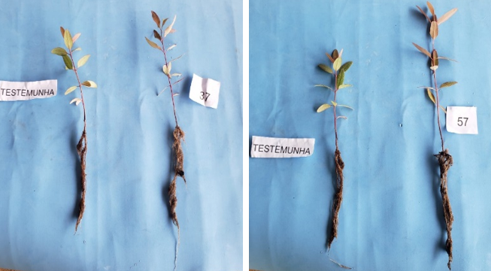
A inoculação com Trichoderma pode aumentar o crescimento em espécies florestais de interesse econômico e ambiental, o que pode contribuir com a redução de fertilizantes. Assim, o presente estudo tem como objetivo avaliar a eficiência da inoculação com Trichoderma, como promotores de crescimento em E. urophylla. Foram utilizados cinco isolados de Trichoderma (UFT-37, UFT-25, UFT-57, UFT-201, UFT-204), bem como a testemunha sem inoculação. Os isolados utilizados foram replicados em placa petri, com meio BDA e incubados em câmara B.O.D. a 27 ± 2 °C, durante sete dias. Após esse período, foi realizada a suspensão aquosa dos esporos. Em seguida, adicionou-se 1 mL de suspensão com o auxílio da pipeta sobre as sementes já nos tubetes. Foram feitas três avaliações, aos 30, 60 e 100 dias após a semeadura (DAS). Os aspectos avaliados são relativos à altura da planta, diâmetro do coleto, massa seca da parte aérea, massa seca da raiz, massa seca total e Índice de Qualidade Dickson (IQD). Com relação aos resultados, todos os isolados avaliados foram superiores à testemunha para a altura, diâmetro do coleto, comprimento radicular, massa seca da parte aérea, da raiz, e índice de qualidade Dickson. No entanto, houve diferenças entre os isolados, com alguns apresentando resultados superiores em comparação com os demais. A Eficiência Relativa também mostrou que os isolados UFT-25, UFT-204 e UFT-201 foram superiores à testemunha, indicando que esses isolados apresentaram um melhor desempenho na promoção do crescimento de E. urophylla. Quanto ao IQD, foi observado que os isolados UFT-201 e UFT-204 apresentaram um melhor desenvolvimento inicial em relação à testemunha, enquanto os demais isolados foram inferiores. No entanto, aos 60 e 100 DAS, todos os isolados foram superiores à testemunha. A aplicação de Trichoderma teve efeitos significativos na promoção do crescimento de mudas de Eucalyptus urophylla.
Referências
Amaral, P. P.; Steffen, G. P. K.; Madame, J.; Missio, E. L.; Saldanha, C. W. Promotores de crescimento na propagação de caroba. Pesquisa Florestal Brasileira, v. 37, n. 90, p. 149-157, 2017.
Azevedo, G. B.; Novaes, Q. S.; Azevedo, G. T. O. S.; Silva, H. F. S.; Sobrinho, G. G. R. Novaes, A. B. N. Efeito de Trichoderma spp. no crescimento de mudas clonais de Eu-calyptus camaldulensis. Scientia Forestalis, v. 45, n. 114, p. 343-352, 2017.
Bononi, L.; Chiaramonte, J. B.; Pansa, C. C.; Moitinho, M. A.; Melo, I. S. Phosphorus-solubilizing Trichoderma spp. from Amazon soils improve soybean plant growth. Scienti-fic Reports, v. 10, n. 2858, p. 1-13, 2020.
Carvalho Filho, M. R.; Mello, S. C. M.; Santos, R. P.; Me-nêzes, J. E. Avaliação de isolados de Trichoderma na pro-moção de crescimento, produção de ácido indolacético in vitro e colonização endofítica de mudas de eucalipto. Brasília (DF): Embrapa Recursos Genéticos e Biotecnologia; 2008.
Chagas Junior, A. F.; Gomes, F. L.; Souza, M. C.; Martins, A. L. L.; De Oliveira, R. S.; Giongo, M.; Chagas, L. F. B. Trichoderma como promotor de crescimento de mudas de eucaliptos. Journal of Biotechnology and Biodiversity, v. 9, n. 1, p. 060-072, 2021.
Chagas, L. F. B.; Chagas Junior, A. F. C.; Soares, L. P.; Fidelis, R. R. Trichoderma na promoção do crescimento vegetal. Revista de Agricultura Neotropical, v. 4, n. 3, p. 97-102, 2017.
Dianese, A. C.; Blum, L. E. B.; Mello, S. C. M. Uso de Tri-choderma spp. para o manejo da podridão-do--pé-do-mamoeiro causada por Phytophthora palmivor Butler. Planaltina-DF: Embrapa Cerrados, 18p. 2012.
Dickson, A.; Leaf, A. L.; Hosner, J. F. Quality appraisal of white spruce and white pineseedling stock in nurseries. For. Chron., v. 36, p. 10-13, 1960.
Druzhinina, I. S.; Komon-Zelazowska, M.; Ismaiel, A.; Jaklitsch, W.; Mullaw, T.; Samuels, G. J.; Kubicek, C. P. Molecular phylogeny and species delimitation in the section Longibrachiatum of Trichoderma. Fungal Genetics and Bi-ology, v. 49, n. 5, p. 358-368, 2012.
Embrapa. Centro Nacional de Pesquisa de Florestas. Espécie de eucalipto urophylla tem maior plasticidade e produtivida-de: Embrapa Meio Ambiente. Brasília, DF: Embrapa, 2021. Disponível em:< https://www.embrapa.br/en/busca-de-noticias/-/noticia/66939049/especie-de-eucalipto-urophylla-tem-maior-plasticidade-e-produtividade>acesso em: ju-nho/2022.
Ferreira, D. F. Sisvar: a computer statistical analysis system. Ciência e Agrotecnologia, v. 35, n. 6, p. 1039-1042, 2011. https://doi.org/10.1590/S1413- 70542011000600001.
Fiorentino, N.; Ventorino, V.; Woo, S. L.; Pepe, O.; Rosa, A.; Gioia, L.; Romano, I.; Lombardi, N.; Napolitano, M.; Colla, G.; Rouphael, Y. Trichoderma-based biostimulants modu-late rhizosphere microbial populations and improve N up-take efficiency, yield, and nutritional quality of leafy vegeta-bles. Frontiers in Plant Science, v. 9, 743, 2018. doi: 10.3389/fpls.2018.00743. PMID: 29922317; PMCID: PMC5996573.
Gasparoto, E. A. G. O panorama do inventário de florestas plantadas no Brasil. 2017. 28 f. Dissertação (Mestrado Ma-nejo Florestal de Precisão) – Universidade Federal do Para-ná.
Gonçalves, R.; de Lima-Primo, H. E.; Schurt, D. A.; Curcino, A.; do Nascimento Cunha, E.; Gomide, P. H. O. Eficiência de Trichoderma spp. na promoção do crescimento de mudas de açaizeiro (Euterpe oleracea Mart.). Revista Brasileira de Agroecologia, v. 17, n. 4, p. 339-353, 2022.
Gravel, V.; Antoun, H.; Tweddell, R. J. Growth stimulation and fruit yield improvement of greenhouse tomato plants by inoculation with Pseudomonas putida or Trichoderma atro-viride: possible role of índole acetic acid (IAA). Soil Biolo-gy and Biochemistry, v. 39, n. 8, p. 1968-1977, 2007.
Hoyos-Carvajal, L.; Orduz, S.; Bissett, J. Genetic and meta-bolic biodiversity of Trichoderma from Colombia and adja-cent neotropic regions. Fungal Genetics and Biology, v. 46, n. 9, p. 615-631, 2009
IBÁ – Industria Brasileira de Árvores: Anuário estatístico 2022. Brasília, 2022. Disponível em:< https://www.iba.org/datafiles/publicacoes/relatorios/relatorio-anual-iba2022-compactado.pdf> acesso em Jan. 2023.
Lucon, C. M. M. Promoção de crescimento de plantas com o uso de Trichoderma spp. 2009. Artigo em Hypertexto. Dis-ponível em: <http://www.infobibos.com/Artigos/2009_1/trichoderma/index.htm>. Acesso em:7/2/2023.
Machado, R. G.; de Sá, E. L. S.; Damasceno, R. G.; Hahn, L.; Almeida, D.; Moraes, T.; Reartes, D. S. Promoção de cres-cimento de Lotus corniculatus L. e Avena strigosa Schreb pela inoculação conjunta de Trichoderma harzianum e rizó-bio. Ciência e Natura, v. 33, n. 2, p. 111-126, 2011.
Pany, T.; Carnus, J.; Freer-Smith, P.; Kimberley, M.; Kollert, W.; Liu, S.; Orazio, C.; Rodriguez, L.; Silva, L. N.; Wing-field, M. J. Changes in planted forests and future global im-plications. Forest Ecology and Management, v. 352, p. 57-67, 2015.
Peccatti, A.; Rovedder, A. P. M.; Steffen, G. P. K.; Maldaner, J.; Camargo, B.; Dalcul, L. P.; Neeuenschwander, F. Bio-logical inputs in promoting the growth of Bauhinia forficata Link. seedlings. Ciência Florestal, v. 30, n. 2, p. 367-379, 2020.
Pereira, F. B. Fungos promotores de crescimento e produção de mudas de Pinus taeda L. 2017. 50 f. Dissertação (Mes-trado em Ciências Florestais), Universidade Estadual do Centro Oeste. UNICENTRO, Irati- PR, 2017.
Samuels, G. J.; Ismaiel, A.; Bon, M. C.; De Respinis, S.; Petrini, O. Trichoderma asperellum sensulato consists of two cryptic species. Mycologia, v. 102, n. 4, p. 944-966, 2010.
Santos, C. H. B. Crescimento de mudas frutíferas sob ação de microrganismos promotores de crescimento. 2017. 82 F. Tese (Doutorado em Agronomia – Produção Vegetal) – Fa-culdade de Ciências Agrárias e Veterinárias, Universidade Estadual Paulista, Jaboticabal, 2017.
Seplan. Secretaria de Planejamento e Meio Ambiente do Esta-do do Tocantins. Diretoria de Zoneamento Ecológico-Econômico. Atlas do Tocantins. Base de Dados Geográfi-cos, Palmas-TO, 2012.
Silva, N. P.; Filippi, M. C. C.; Gonçalves, F. J.; Souza, A. C. A. Biocontrole de Macrophomina phaseolina e promoção do crescimento na cultura do girassol com o uso de Tricho-derma sp. e rizobactérias. Ipê Agronomic Journal, v. 5, n. 1, p. 1-14, 2021.
Souza, O. M. M. Aptidão agroclimática e ambiental do Eu-calyptus urophylla para a região do MATOPIBA. 2017. 85f. Dissertação (Mestrado em Agroenergia). Universidade Federal do Tocantins, Palmas, TO. 2017.
Steffen, G.; Maldaner, J.; Steffen, R.; Saldanha, C.; Peccatti, A. Trichoderma asperelloides promove crescimento inicial em mudas de Corymbia citriodora. Enciclopedia Biosfera, v. 16, n. 29, p. 1699-1708, 2019.
Teale, W.; Paponov, I.; Palme, K. Auxin in action: signalling, transport and the control of plant growth and development. Nature Reviews Molecular Cell Biology, v. 7, p. 847-859, 2006.
Tomazzi, D. J.; Steffen, R. B.; Gabe, N. L.; da Silva, R. F.; Mortari, J. L. M.; Maldaner, J. Incremento da produtividade de milho pelo uso de Trichoderma harzianum TF13. Brazi-lian Journal of Development, v. 7, n. 1, p. 4455-4468, 2021.
Vidal, L. H. I.; Souza, J. R. P. D.; Fonseca, É. D. P.; Bordin, I. Qualidade de mudas de guaco produzidas por estaquia em casca de arroz carbonizada com vermicomposto. Horticultu-ra Brasileira, v. 24, p. 26-30, 2006.
Downloads
Publicado
Como Citar
Edição
Seção
Licença
Copyright (c) 2025 Aloisio Freitas Chagas Jr, Adriana Santos Neves Ribeiro, Lillian França Borges Chagas, Gabriel Soares Nobrega, Marcos Giongo, Dalilla Moreira de Oliveira Moura, Ana Licia Leão Ferreira, Leticia Bezerra de Almeida, Damiana Beatriz da Silva

Este trabalho está licenciado sob uma licença Creative Commons Attribution 4.0 International License.
Copyright (c) 2024 - Journal of Biotechnology and Biodiversity

Este obra está licenciado com uma Licença Creative Commons Atribuição 4.0 Internacional.
Autores que publicam nesta revista concordam com os seguintes termos:
Autores mantêm os direitos autorais e concedem à revista o direito de primeira publicação, com o trabalho simultaneamente licenciado sob a Licença Creative Commons Attribution (CC BY 4.0 no link http://creativecommons.org/licenses/by/4.0/) que permite o compartilhamento do trabalho com reconhecimento da autoria e publicação inicial nesta revista.
Autores têm autorização para assumir contratos adicionais separadamente, para distribuição não exclusiva da versão do trabalho publicada nesta revista (ex.: publicar em repositório institucional ou como capítulo de livro), com reconhecimento de autoria e publicação inicial nesta revista.
Autores têm permissão e são estimulados a publicar e distribuir seu trabalho online (ex.: em repositórios institucionais ou na sua página pessoal) a qualquer momento antes ou durante o processo editorial, já que isso pode gerar alterações produtivas, bem como aumentar o impacto e a citação do trabalho publicado (disponibilizado em O Efeito do Acesso Livre no link http://opcit.eprints.org/oacitation-biblio.html).