Investigating compositional and sulfite content variability in a range of sug-ar types using comparative analytical methodologies
DOI:
https://doi.org/10.20873/jbb.uft.cemaf.v14n2.21350Keywords:
crystal sugar, sulfite, ICUMSA, Monier-Williams, sugarcane, compositional analysisAbstract
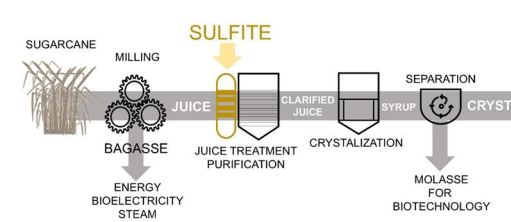
Sugar production, with sugarcane as its primary raw material, positions Brazil as a global leader in crystal sugar output. During the sugarcane processing stages, sulfur derivatives, such as sulfite, are used as clarifying agents in white sugar production. The analysis of crystal sugar samples revealed their compliance with current legislation regarding parameters like conductivity ash, color, polarization, and insoluble mineral residue. However, the official ICUMSA methodology for sulfite analysis was tested against an alternative method based on the Monier-Williams reaction. The results obtained with the alternative method showed significantly higher sulfite values compared to the official method. Hot reflux distillation, used in the Monier-Williams method, demonstrated that the samples contained elevated sulfite levels, up to 6.9 (raw VHP), 25.8 (white type 1), and 13.9 (white type 2) times greater. The difference in results can be attributed to the fact that the hot reflux distillation process may promote the conversion of other sulfur derivatives present in the sample into sulfite, thus overestimating the values when compared to the official method. This finding showed that both methodologies are applicable, provided the analytical necessity is indicated, i.e., whether only sulfite levels or the totality of sulfur forms present in the sugar samples are required.
References
AGUIAR, C. L.; ROCHA, A. L. B.; JAMBASSI, J. R.; LIMA, R. B.; LIMA, R. B. Factors affecting color formation during storage of white crystal sugar. Focusing on Modern Food Industry, [s. l.], v. 4, n. 0, p. 1, 2015. https://doi.org/10.14355/fmfi.2015.04.001.
ALAM, M. W. et al. Emerging trends in food process engineering: Integrating sensing technologies for health, sustainability, and consumer preferences. Journal of Food Process Engineering, [s. l.], v. 48, n. 1, e70035, 2025. https://doi.org/10.1111/jfpe.70035.
ALMEIDA, M. A.; COLOMBO, R. Production chain of first-generation sugarcane bioethanol: Characterization and value-added application of wastes. BioEnergy Research, [s. l.], v. 16, n. 2, p. 924-939, 2023. https://doi.org/10.1007/s12155-023-10502-6.
AWULACHEW, M. T. A systematic review of sugar processing sector and food safety. Journal of Agriculture and Food Research, n. 16, p. 197, 2025.
BARROS, M. C. S. Determinação de sulfitos em açúcar branco. 2018. Trabalho de Conclusão de Curso (Licenciatura em Química) – Instituto Federal de Goiás, [Goiânia], 2018. https://repositorio.ifg.edu.br/bitstream/prefix/636/1/TCC%20Licenciatura%20em%20Qu%C3%ADmica%202018%20-%20Maria%20Cristina%20Souto%20Barros.pdf.
BEAUCHAMP, R. O. et al. A critical review of the literature on hydrogen sulfide toxicity. CRC Critical Reviews in Toxicology, [s. l.], v. 13, n. 1, p. 25-97, 1984. https://doi.org/10.3109/10408448409029321.
BRAGAGNOLO, N.; SILVA, C. A.; TANIWAKI, M. H. Avaliação dos teores de dióxido de enxofre e da qualidade microbiológica de cogumelos em conserva. Revista do Instituto Adolfo Lutz, [s. l.], v. 60, n. 2, p. 103-7, 2001.
BRASIL. Decreto nº 55.871, de 26 de março de 1965. Brasília, DF: Presidência da República, 1965. https://www.planalto.gov.br/ccivil_03/decreto/1950-1969/d55871.htm.
BRITO, A. L. B.; CARDOSO, I. F.; VIEGAS, L. P.; FAUSTO, R. Semi-quantitative chemometric models for characterization of mixtures of sugars using infrared spectral data. Spectrochimica Acta Part A: Molecular and Biomolecular Spectroscopy, [s. l.], v. 326, n. 5, p. 125225, 2025.
https://doi.org/10.1016/j.saa.2024.125225.
BROWNE, C. A. The Deterioration of Raw Cane Sugar: A Problem in Food Conservation. Industrial & Engineering Chemistry, [s. l.], v. 10, n. 3, p. 178-190, 1918.
CAMPIOL, J. L. M. et al. Color reduction of raw sugar syrup using hydrogen peroxide. Brazilian Journal of Food Technology, Campinas, v. 22, e2018072, 2019. https://doi.org/10.1590/1981-6723.18019.
CHANDRAN, K. et al. Sugarcane-based traditional sweeteners and health benefits. In: Value addition and product diversification in sugarcane. Singapore: Springer Nature Singapore, 2024. p. 269-293.
https://doi.org/10.1007/978-981-99-7265-7_15.
CHANG, F.; ENG, L.; CHANG, C. Food allergy labeling laws: International guidelines for residents and travelers. Clinical Reviews in Allergy & Immunology, [s. l.], v. 65, n. 2, p. 148-165, 2023.
COZZOLINO, D. Advances in spectrometric techniques in food analysis and authentication. Foods, [s. l.], v. 12, n. 3, p. 438, 2023.
https://doi.org/10.3390/foods12030438.
COZZOLINO, D. An overview of the successful application of vibrational spectroscopy techniques to quantify nutraceuticals in fruits and plants. Foods, [s. l.], v. 11, n. 3, p. 315, 2022.
https://doi.org/10.3390/foods11030315.
DIAS, M. O. de S. et al. Sugarcane processing for ethanol and sugar in Brazil. Environmental Development, [s. l.], v. 15, p. 35-51, 2015. https://doi.org/10.1016/j.envdev.2015.03.004.
DI-TANNO, M. F. P. et al. Effect of ozonation time on the clarification of juice of sugarcane varieties. International Journal of Food Science and Agriculture, [s. l.], v. 5, n. 1, 2021.
http://dx.doi.org/10.26855/ijfsa.2021.03.026.
DORDEVIC, D. et al. Sulfur content in foods and beverages and its role in human and animal metabolism: A scoping review of recent studies. Heliyon, [s. l.], v. 9, n. 4, 2023. https://doi.org/10.1016/j.heliyon.2023.e15452.
DUARTE, A. et al. Proposal of operating best practices that contribute to the technical efficiency in Brazilian sugar and ethanol mills. Journal of Cleaner Production, [s. l.], v. 214, p. 173-184, 2019. https://doi.org/10.1016/j.jclepro.2018.12.204.
EGGLESTON, G.; LEGENDRE, B.; GODSHALL, M. A. Sugar and other sweeteners. In: Handbook of industrial chemistry and biotechnology. [S. l.]: Springer, 2017. p. 933-978.
https://doi.org/10.1007/978-1-4939-3444-0_41.
EGOROVA, M. et al. Risks of failing to achieve white sugar color standards. In: E3S Web of Conferences. [S. l.]: EDP Sciences, 2025. v. 613, p. 05007. https://doi.org/10.1051/e3sconf/202561305007.
GEORGE, A. S. Leveraging industry 4.0 for efficiency gains in food production. Partners Universal International Research Journal, [s. l.], v. 3, n. 1, p. 86-108, 2024.
GORODETSKY, V. O. et al. Identification of influential patterns of sulfitation treatment of sugar production thick juice and remelt on the beet sugar quality. New Technologies, [s. l.], v. 18, n. 2, p. 35–43, 2022. https://doi.org/10.47370/2072-0920-2022-18-2-35-43.
GUPTA, M. K.; BASAVARAJ, G. V. Sulphites in food & drinks in asthmatic adults & children: What we need to know. Indian Journal of Allergy, Asthma and Immunology, [s. l.], v. 35, n. 2, p. 43-47, 2021. https://doi.org/10.4103/ijaaai.ijaaai_28_21.
ICUMSA. ICUMSA Methods Book. [S. l.]: International Commission for Uniform Methods of Sugar Analysis Ltd., 2017. https://www.icumsa.org/index.php?id=174.
JADHAV, S. P.; SHAH, U. B.; SHELKE, K. Current Facts about Clean Label Food Products. In: Food Intolerances. [S. l.]: CRC Press, 2025. p. 162-200.
JAEGER, A.; BANKS, D. Cluster analysis: A modern statistical review. Wiley Interdisciplinary Reviews: Computational Statistics, [s. l.], v. 15, n. 3, e1597, 2023. https://doi.org/10.1002/wics.1597.
KHALAF, E. M. et al. Effects of sulfur dioxide inhalation on human health: A review. Reviews on Environmental Health, [s. l.], v. 39, n. 2, p. 331-337, 2024.
MACHADO, R. M. D.; TOLEDO, M. C. F.; VICENTE, E. Sulfitos em alimentos. Brazilian Journal of Food Technology, Campinas, v. 9, n. 4, p. 265-275, 2006. https://doi.org/10.1590/S1981-67232006000400001.
MINISTÉRIO DA AGRICULTURA, PECUÁRIA E ABASTECIMENTO (MAPA). Instrução Normativa nº 47, de 30 de agosto de 2018. Brasília, DF: Ministério da Agricultura, Pecuária e Abastecimento, 2018. https://sistemasweb.agricultura.gov.br/sislegis/action/detalhaAto.do?method=visualizarAtoPortalMapa&chave=633451773.
MIRANDA, E. E.; FONSECA, M. F. Sugarcane: Food production, energy, and environment. In: Sugarcane biorefinery, technology and perspectives. [S. l.]: Academic Press, 2020. p. 67-88. https://doi.org/10.1016/B978-0-12-816453-1.00004-5.
MOLINA-CORTÉS, A.; QUIMBAYA, M.; TORO-GOMEZ, A.; TOBAR-TOSSE, F. Bioactive compounds as an alternative for the sugarcane industry: Towards an integrative approach. Heliyon, [s. l.], v. 9, n. 2, e13276, 2023. https://doi.org/10.1016/j.heliyon.2023.e13276.
NAGATO, L. A. F.; TAKEMOTO, E.; DELLA TORRE, J. C. M.; LICHTIG, J. Verificação do método de Monier-Williams otimizado na determinação de dióxido de enxofre em sucos de frutas, água de coco e cogumelo em conserva. Revista do Instituto Adolfo Lutz, [s. l.], v. 72, n. 1, p. 34-48, 2013.
NOVAIS, C. et al. Natural food colorants and preservatives: A review, a demand, and a challenge. Journal of Agricultural and Food Chemistry, [s. l.], v. 70, n. 9, p. 2789-2805, 2022. https://doi.org/10.1021/acs.jafc.1c08000.
OGANDO, F. I. B. et al. Removal of color and turbidity in sugarcane juice treated by electrocoagulation with aluminum electrodes. Brazilian Journal of Food Technology, Campinas, v. 24, e2020236, 2021. https://doi.org/10.1590/1981-6723.23620.
PANG, Z. et al. MetaboAnalyst 5.0: Narrowing the gap between raw data and systems-level insights. Nucleic Acids Research, [s. l.], v. 49, n. W1, p. W388-W396, 2021.
https://doi.org/10.1093/nar/gkab382.
POSTGATE, J. R. The sulphate-reducing bacteria. [S. l.]: CUP Archive, 1979.
RAMADAN, N. H.; EL-SAYIAD, S. I.; DARWISH, S. M.; RAMADAN, E. S. A.; AHMED, M. A. Physicochemical properties and polarization value in raw and refined sugar. Egyptian Sugar Journal, v. 19, n. 19, p. 82-90, 2022.
REIN, P. Cane Sugar Engineering. Berlin: Verlag Dr. Albert Bartens, 2007.
SARTORI, J. A. D. S. et al. Sugarcane juice clarification by hydrogen peroxide: Predictions with artificial neural networks. International Journal of Food Engineering, [s. l.], v. 13, n. 2, 20160199, 2017. https://doi.org/10.1515/ijfe-2016-0199.
WANG, C.; LU, W.; LUO, M.; XIE, C.; LI, K.; HANG, F. Removal of colorants from sugarcane juice and remelt syrup by bagasse-based biochar–hydroxyapatite composites. Sugar Tech, v. 25, n. 6, p. 1492-1500, 2023. https://doi.org/10.1007/s12355-023-01314-8.
WITKOWSKI, M.; GRAJETA, H.; GOMUŁKA, K. Hypersensitivity reactions to food additives—Preservatives, antioxidants, flavor enhancers. International Journal of Environmental Research and Public Health, [s. l.], v. 19, n. 18, 11493, 2022. https://doi.org/10.3390/ijerph191811493.
Downloads
Published
How to Cite
Issue
Section
License
Copyright (c) 2026 Guilherme Hernandez Loretti, Claudio Lima

This work is licensed under a Creative Commons Attribution 4.0 International License.
Copyright (c) 2024 - Journal of Biotechnology and Biodiversity

This work is licensed under a Creative Commons Attribution 4.0 International License.
Authors who publish with this journal agree to the following terms:
Authors retain copyright and grant the journal right of first publication with the work simultaneously licensed under a Creative Commons Attribution License (CC BY 4.0 at http://creativecommons.org/licenses/by/4.0/) that allows others to share the work with an acknowledgement of the work's authorship and initial publication in this journal.
Authors are able to enter into separate, additional contractual arrangements for the non-exclusive distribution of the journal's published version of the work (e.g., post it to an institutional repository or publish it in a book), with an acknowledgement of its initial publication in this journal.
Authors are permitted and encouraged to post their work online (e.g. in institutional repositories or on their website) prior to and during the submission process, as it can lead to productive exchanges, as well as earlier and greater citation of published work (Available at The Effect of Open Access, at http://opcit.eprints.org/oacitation-biblio.html).