Investigação da variabilidade da composição e do teor de sulfito em diversos tipos de açúcar utilizando metodologias analíticas comparativas
DOI:
https://doi.org/10.20873/jbb.uft.cemaf.v14n2.21350Palavras-chave:
açúcar cristal, sulfito, ICUMSA, Monier-Williams, cana-de-açúcar, análise composicionalResumo
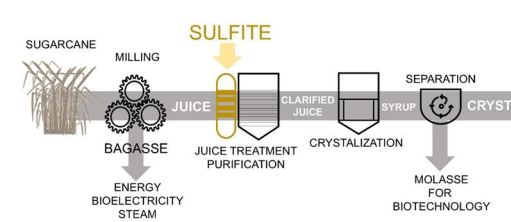
A produção de açúcar, tendo a cana-de-açúcar como principal matéria-prima, coloca o Brasil como um dos líderes mundiais na produção de açúcar cristal. Durante as etapas do processamento da cana, derivados de enxofre, como o sulfito, são utilizados como agentes de clarificação na produção de açúcar branco. A análise de amostras de açúcar cristal revelou que estas estão em conformidade com a legislação vigente em relação a parâmetros como cinzas condutimétricas, cor, polarização e resíduo mineral insolúvel. No entanto, a metodologia oficial da ICUMSA para análise de sulfito foi testada frente a uma metodologia alternativa, baseada na reação de Monier-Williams. Os resultados obtidos com o método alternativo apresentaram valores de sulfito expressivamente maiores em comparação com o método oficial. A destilação em refluxo a quente, utilizada no método Monier-Williams, demonstrou que as amostras continham teores mais elevados de sulfito, em até 6,9 (VHP bruto), 25,8 (branco tipo 1) e 13,9 (branco tipo 2) vezes maior. A diferença nos resultados pode ser atribuída ao fato de que o processo de destilação em refluxo a quente pode promover a conversão de outros derivados de enxofre presentes na amostra em sulfito, superestimando os valores encontrados quando comparados ao método oficial. Esse fato demonstrou que tanto uma quanto outra metodologia são aplicáveis desde se indique a necessidade analítica, ou seja, se apenas teores de sulfito ou a totalidade das formas de enxofre presentes nas amostras de açúcar.
Referências
AGUIAR, C. L.; ROCHA, A. L. B.; JAMBASSI, J. R.; LIMA, R. B.; LIMA, R. B. Factors affecting color formation during storage of white crystal sugar. Focusing on Modern Food Industry, [s. l.], v. 4, n. 0, p. 1, 2015. https://doi.org/10.14355/fmfi.2015.04.001.
ALAM, M. W. et al. Emerging trends in food process engineering: Integrating sensing technologies for health, sustainability, and consumer preferences. Journal of Food Process Engineering, [s. l.], v. 48, n. 1, e70035, 2025. https://doi.org/10.1111/jfpe.70035.
ALMEIDA, M. A.; COLOMBO, R. Production chain of first-generation sugarcane bioethanol: Characterization and value-added application of wastes. BioEnergy Research, [s. l.], v. 16, n. 2, p. 924-939, 2023. https://doi.org/10.1007/s12155-023-10502-6.
AWULACHEW, M. T. A systematic review of sugar processing sector and food safety. Journal of Agriculture and Food Research, n. 16, p. 197, 2025.
BARROS, M. C. S. Determinação de sulfitos em açúcar branco. 2018. Trabalho de Conclusão de Curso (Licenciatura em Química) – Instituto Federal de Goiás, [Goiânia], 2018. https://repositorio.ifg.edu.br/bitstream/prefix/636/1/TCC%20Licenciatura%20em%20Qu%C3%ADmica%202018%20-%20Maria%20Cristina%20Souto%20Barros.pdf.
BEAUCHAMP, R. O. et al. A critical review of the literature on hydrogen sulfide toxicity. CRC Critical Reviews in Toxicology, [s. l.], v. 13, n. 1, p. 25-97, 1984. https://doi.org/10.3109/10408448409029321.
BRAGAGNOLO, N.; SILVA, C. A.; TANIWAKI, M. H. Avaliação dos teores de dióxido de enxofre e da qualidade microbiológica de cogumelos em conserva. Revista do Instituto Adolfo Lutz, [s. l.], v. 60, n. 2, p. 103-7, 2001.
BRASIL. Decreto nº 55.871, de 26 de março de 1965. Brasília, DF: Presidência da República, 1965. https://www.planalto.gov.br/ccivil_03/decreto/1950-1969/d55871.htm.
BRITO, A. L. B.; CARDOSO, I. F.; VIEGAS, L. P.; FAUSTO, R. Semi-quantitative chemometric models for characterization of mixtures of sugars using infrared spectral data. Spectrochimica Acta Part A: Molecular and Biomolecular Spectroscopy, [s. l.], v. 326, n. 5, p. 125225, 2025.
https://doi.org/10.1016/j.saa.2024.125225.
BROWNE, C. A. The Deterioration of Raw Cane Sugar: A Problem in Food Conservation. Industrial & Engineering Chemistry, [s. l.], v. 10, n. 3, p. 178-190, 1918.
CAMPIOL, J. L. M. et al. Color reduction of raw sugar syrup using hydrogen peroxide. Brazilian Journal of Food Technology, Campinas, v. 22, e2018072, 2019. https://doi.org/10.1590/1981-6723.18019.
CHANDRAN, K. et al. Sugarcane-based traditional sweeteners and health benefits. In: Value addition and product diversification in sugarcane. Singapore: Springer Nature Singapore, 2024. p. 269-293.
https://doi.org/10.1007/978-981-99-7265-7_15.
CHANG, F.; ENG, L.; CHANG, C. Food allergy labeling laws: International guidelines for residents and travelers. Clinical Reviews in Allergy & Immunology, [s. l.], v. 65, n. 2, p. 148-165, 2023.
COZZOLINO, D. Advances in spectrometric techniques in food analysis and authentication. Foods, [s. l.], v. 12, n. 3, p. 438, 2023.
https://doi.org/10.3390/foods12030438.
COZZOLINO, D. An overview of the successful application of vibrational spectroscopy techniques to quantify nutraceuticals in fruits and plants. Foods, [s. l.], v. 11, n. 3, p. 315, 2022.
https://doi.org/10.3390/foods11030315.
DIAS, M. O. de S. et al. Sugarcane processing for ethanol and sugar in Brazil. Environmental Development, [s. l.], v. 15, p. 35-51, 2015. https://doi.org/10.1016/j.envdev.2015.03.004.
DI-TANNO, M. F. P. et al. Effect of ozonation time on the clarification of juice of sugarcane varieties. International Journal of Food Science and Agriculture, [s. l.], v. 5, n. 1, 2021.
http://dx.doi.org/10.26855/ijfsa.2021.03.026.
DORDEVIC, D. et al. Sulfur content in foods and beverages and its role in human and animal metabolism: A scoping review of recent studies. Heliyon, [s. l.], v. 9, n. 4, 2023. https://doi.org/10.1016/j.heliyon.2023.e15452.
DUARTE, A. et al. Proposal of operating best practices that contribute to the technical efficiency in Brazilian sugar and ethanol mills. Journal of Cleaner Production, [s. l.], v. 214, p. 173-184, 2019. https://doi.org/10.1016/j.jclepro.2018.12.204.
EGGLESTON, G.; LEGENDRE, B.; GODSHALL, M. A. Sugar and other sweeteners. In: Handbook of industrial chemistry and biotechnology. [S. l.]: Springer, 2017. p. 933-978.
https://doi.org/10.1007/978-1-4939-3444-0_41.
EGOROVA, M. et al. Risks of failing to achieve white sugar color standards. In: E3S Web of Conferences. [S. l.]: EDP Sciences, 2025. v. 613, p. 05007. https://doi.org/10.1051/e3sconf/202561305007.
GEORGE, A. S. Leveraging industry 4.0 for efficiency gains in food production. Partners Universal International Research Journal, [s. l.], v. 3, n. 1, p. 86-108, 2024.
GORODETSKY, V. O. et al. Identification of influential patterns of sulfitation treatment of sugar production thick juice and remelt on the beet sugar quality. New Technologies, [s. l.], v. 18, n. 2, p. 35–43, 2022. https://doi.org/10.47370/2072-0920-2022-18-2-35-43.
GUPTA, M. K.; BASAVARAJ, G. V. Sulphites in food & drinks in asthmatic adults & children: What we need to know. Indian Journal of Allergy, Asthma and Immunology, [s. l.], v. 35, n. 2, p. 43-47, 2021. https://doi.org/10.4103/ijaaai.ijaaai_28_21.
ICUMSA. ICUMSA Methods Book. [S. l.]: International Commission for Uniform Methods of Sugar Analysis Ltd., 2017. https://www.icumsa.org/index.php?id=174.
JADHAV, S. P.; SHAH, U. B.; SHELKE, K. Current Facts about Clean Label Food Products. In: Food Intolerances. [S. l.]: CRC Press, 2025. p. 162-200.
JAEGER, A.; BANKS, D. Cluster analysis: A modern statistical review. Wiley Interdisciplinary Reviews: Computational Statistics, [s. l.], v. 15, n. 3, e1597, 2023. https://doi.org/10.1002/wics.1597.
KHALAF, E. M. et al. Effects of sulfur dioxide inhalation on human health: A review. Reviews on Environmental Health, [s. l.], v. 39, n. 2, p. 331-337, 2024.
MACHADO, R. M. D.; TOLEDO, M. C. F.; VICENTE, E. Sulfitos em alimentos. Brazilian Journal of Food Technology, Campinas, v. 9, n. 4, p. 265-275, 2006. https://doi.org/10.1590/S1981-67232006000400001.
MINISTÉRIO DA AGRICULTURA, PECUÁRIA E ABASTECIMENTO (MAPA). Instrução Normativa nº 47, de 30 de agosto de 2018. Brasília, DF: Ministério da Agricultura, Pecuária e Abastecimento, 2018. https://sistemasweb.agricultura.gov.br/sislegis/action/detalhaAto.do?method=visualizarAtoPortalMapa&chave=633451773.
MIRANDA, E. E.; FONSECA, M. F. Sugarcane: Food production, energy, and environment. In: Sugarcane biorefinery, technology and perspectives. [S. l.]: Academic Press, 2020. p. 67-88. https://doi.org/10.1016/B978-0-12-816453-1.00004-5.
MOLINA-CORTÉS, A.; QUIMBAYA, M.; TORO-GOMEZ, A.; TOBAR-TOSSE, F. Bioactive compounds as an alternative for the sugarcane industry: Towards an integrative approach. Heliyon, [s. l.], v. 9, n. 2, e13276, 2023. https://doi.org/10.1016/j.heliyon.2023.e13276.
NAGATO, L. A. F.; TAKEMOTO, E.; DELLA TORRE, J. C. M.; LICHTIG, J. Verificação do método de Monier-Williams otimizado na determinação de dióxido de enxofre em sucos de frutas, água de coco e cogumelo em conserva. Revista do Instituto Adolfo Lutz, [s. l.], v. 72, n. 1, p. 34-48, 2013.
NOVAIS, C. et al. Natural food colorants and preservatives: A review, a demand, and a challenge. Journal of Agricultural and Food Chemistry, [s. l.], v. 70, n. 9, p. 2789-2805, 2022. https://doi.org/10.1021/acs.jafc.1c08000.
OGANDO, F. I. B. et al. Removal of color and turbidity in sugarcane juice treated by electrocoagulation with aluminum electrodes. Brazilian Journal of Food Technology, Campinas, v. 24, e2020236, 2021. https://doi.org/10.1590/1981-6723.23620.
PANG, Z. et al. MetaboAnalyst 5.0: Narrowing the gap between raw data and systems-level insights. Nucleic Acids Research, [s. l.], v. 49, n. W1, p. W388-W396, 2021.
https://doi.org/10.1093/nar/gkab382.
POSTGATE, J. R. The sulphate-reducing bacteria. [S. l.]: CUP Archive, 1979.
RAMADAN, N. H.; EL-SAYIAD, S. I.; DARWISH, S. M.; RAMADAN, E. S. A.; AHMED, M. A. Physicochemical properties and polarization value in raw and refined sugar. Egyptian Sugar Journal, v. 19, n. 19, p. 82-90, 2022.
REIN, P. Cane Sugar Engineering. Berlin: Verlag Dr. Albert Bartens, 2007.
SARTORI, J. A. D. S. et al. Sugarcane juice clarification by hydrogen peroxide: Predictions with artificial neural networks. International Journal of Food Engineering, [s. l.], v. 13, n. 2, 20160199, 2017. https://doi.org/10.1515/ijfe-2016-0199.
WANG, C.; LU, W.; LUO, M.; XIE, C.; LI, K.; HANG, F. Removal of colorants from sugarcane juice and remelt syrup by bagasse-based biochar–hydroxyapatite composites. Sugar Tech, v. 25, n. 6, p. 1492-1500, 2023. https://doi.org/10.1007/s12355-023-01314-8.
WITKOWSKI, M.; GRAJETA, H.; GOMUŁKA, K. Hypersensitivity reactions to food additives—Preservatives, antioxidants, flavor enhancers. International Journal of Environmental Research and Public Health, [s. l.], v. 19, n. 18, 11493, 2022. https://doi.org/10.3390/ijerph191811493.
Downloads
Publicado
Como Citar
Edição
Seção
Licença
Copyright (c) 2026 Guilherme Hernandez Loretti, Claudio Lima

Este trabalho está licenciado sob uma licença Creative Commons Attribution 4.0 International License.
Copyright (c) 2024 - Journal of Biotechnology and Biodiversity

Este obra está licenciado com uma Licença Creative Commons Atribuição 4.0 Internacional.
Autores que publicam nesta revista concordam com os seguintes termos:
Autores mantêm os direitos autorais e concedem à revista o direito de primeira publicação, com o trabalho simultaneamente licenciado sob a Licença Creative Commons Attribution (CC BY 4.0 no link http://creativecommons.org/licenses/by/4.0/) que permite o compartilhamento do trabalho com reconhecimento da autoria e publicação inicial nesta revista.
Autores têm autorização para assumir contratos adicionais separadamente, para distribuição não exclusiva da versão do trabalho publicada nesta revista (ex.: publicar em repositório institucional ou como capítulo de livro), com reconhecimento de autoria e publicação inicial nesta revista.
Autores têm permissão e são estimulados a publicar e distribuir seu trabalho online (ex.: em repositórios institucionais ou na sua página pessoal) a qualquer momento antes ou durante o processo editorial, já que isso pode gerar alterações produtivas, bem como aumentar o impacto e a citação do trabalho publicado (disponibilizado em O Efeito do Acesso Livre no link http://opcit.eprints.org/oacitation-biblio.html).