Fire behavior in typical Cerrado phytophysiognomy in Tocantins
DOI:
https://doi.org/10.20873/jbb.uft.cemaf.v14n1.21224Keywords:
biodiversity, fuel load, prescribed fire, climatic variablesAbstract
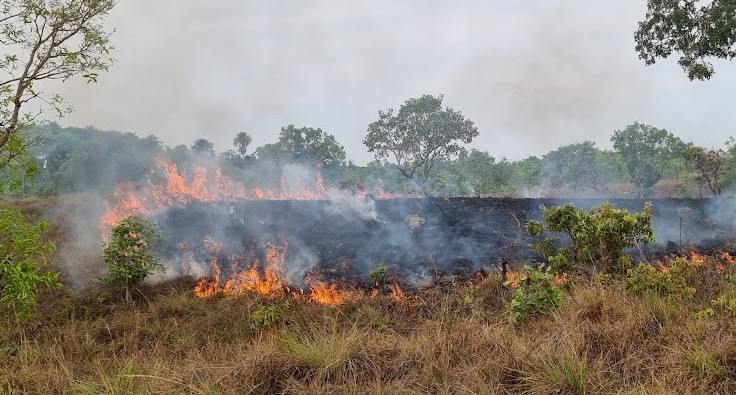
This study aimed to analyze fire behavior in a typical Cerrado area at Fazenda Verdes Mares, Sucupira-TO. Experimental burns were conducted on 14 plots during the dry season (in october) to evaluate flame height, propagation speed, fire intensity, and heat release, correlating these with fuel load and climatic variables. The results showed average values of 49.91 cm (± 5.13) for flame height, 1.83 m/min (± 0.43) for propagation speed, 82.30 Kcal/m/s (± 19.91) for fire intensity, and 2,879.35 kcal/m² (± 224.73) for heat release. A significant correlation (p<0.05) was observed between fire behavior and climatic variables such as air temperature, wind speed, and relative humidity. Adjusted regression models reliably estimated fire behavior (R² > 0.91), with climatic variables explaining the variation, especially wind speed. The study demonstrates the importance of climatic conditions in fire behavior in typical Cerrado areas, which is essential for proper management and fire prevention.
References
Anderson MK. The ethnobotany of deergrass, Muhlenbergia rigens (Poaceae): its uses and fire management by California Indian Tribes. Economic Botany, v. 50, p. 409-422, 1996. https://link.springer.com/article/10.1007/BF02866523
Batista AC. Incêndios florestais. Recife: UFRPE, 115p, 1990.
Beutling A. Modelagem do comportamento do fogo com base em Experimentos laboratoriais e de campo. Curitiba, 2009. 121f. Tese (Doutorado em Engenharia Florestal) – Setor de Ciências Agrárias, Universidade Federal do Paraná.
Bond WJ, Woodward FI, Midgley GF. The global distribution of ecosystems in a world without fire. New Phytologist, p. 525-538, 2005.
https://doi.org/10.1111/j.1469-8137.2004.01252.x
Brown JK, Reinhardt ED, Fischer WC. Predicting duff and woody fuel consumption in Northern Idaho prescribed fires. Forest Science, v. 37, n.6, p.1550-1566, 1991. https://doi.org/10.1093/forestscience/37.6.1550
Byram GM. Combustion of forest fuels. In: Davis, Kp. Forest fire - control and use. New York: Mc Graw Hill, p. 77-84, 1959.
Camargos VL, Ribeiro GA, da Silva AF, Martins SV, da Silva Carmo, FM. Estudo do comportamento do fogo em um trecho de floresta estacional semidecídua no município de Viçosa, Minas Gerais. Ciência Florestal, v. 25, n. 3, 2015, p. 537-545.
https://doi.org/10.5902/1980509819605
Castro EA, Kauffman, JB. Ecosystem structure in the Brazilian Cerrado: A vegetation gradient of aboveground biomass, root mass and consumption by fire. Journal of Tropical Ecology, v.14, n.3, p.263-283, 1998. https://www.jstor.org/stable/2559908
Conceição A, Pivello VR. Biomassa Combustível em Campo Sujo no Entorno do Parque Nacional da Chapada Diamanti-na, Bahia, Brasil. Biodiversidade Brasileira, v.1, n.2, p.146-160, 2011.
https://doi.org/10.37002/biodiversidadebrasileira.v1i2.112
Embrapa - Empresa Brasileira de Pesquisa Agropecuária. Embrapa Cerrados e a região dos Cerrados: informa-ções básicas e dados estatísticos. Planaltina, 24p, 1998.
Figueiredo Filho DB, Silva Júnior JA. Visão além do alcance: uma introdução à análise fatorial. Opinião pública, v.16, n.1, p.160-185, 2010.
https://doi.org/10.1590/S0104-62762010000100007
Goldammer JG. Wildfire management in forests and other vegetation : A global perspective. Disaster Management, v. 5, n. 1, p.3-10, 1993.
Hair Jr, JF, Black WC, Babin BJ, Anderson RE. Multivariate Data Analysis. New Jersey: Pearson Prentice Hall, 2006. 816 p.
Henriques RPB, Hay JDV. Patterns and dynamics of plant populations. In: Oliveira, OS, Marquis, RJ. (Eds.). The Cerrados of Brazil: ecology and natural history of a ne-otropical savanna. New York: Columbia University Press, p.140-158, 2002.
INMET - Instituto Nacional De Meteorologia. Dados Clima-tológicos. Disponivel em <http://www.inmet.gov.br/portal/index.php?r=tempo/graficos>. Acesso em 10 de janeiro de 2017.
Klink CA, Machado RB. Conservation of the brazilian Cerra-do. Conservation Biology, v. 19, n. 3, p.707-713, 2005. https://doi.org/10.1111/j.1523-1739.2005.00702.x
Medeiros MB, Miranda HS. Mortalidade pós-fogo em espé-cies lenhosas de campo sujo submetido a três queimadas prescritas anuais São Paulo, Brasil. Acta Botanica Brasi-leira, v. 19, n. 3, p. 493-500, 2005. https://doi.org/10.1590/S0102-33062005000300009
Menezes R, Souza BI. Manejo sustentável dos recursos natu-rais em uma comunidade rural do semiárido nordestino, Pa-raíba, Brasil. Cadernos do Logepa, v.6, n.1, p.41‐57, 2011. https://periodicos.ufpb.br/index.php/logepa/article/view/10571
Miranda HS, Rocha e Silva, EP, Miranda AC. Comportamen-to do fogo em queimadas de campo sujo. In: Miranda HS, Saito CH, Dias BFS. (Org.) Impactos de queimadas em áreas de cerrado e restinga. Brasília: UnB, ECL, p. 1-10, 1996.
Pivello VR. Fire management for biological conservation in the Brazilian Cerrado. In: Mistry J, Berardi A. Savannas and dry forests – linking people with nature. Ashgate, Hants, p.129-154, 2006.
Projeto MapBiomas – Coleção 10 da Série Anual de Mapas de Cobertura e Uso da Terra do Brasil, 2025.
Ramos Neto MB. Avaliação do manejo do fogo no Parque Nacional das Emas. In: Anais do Congresso Brasileiro de Unidades de Conservação, p. 670-683, 1997.
Ribeiro GA, Soares RV. Caracterização do material combustí-vel superficial e efeitos da queima controlada sobre sua re-dução em um povoamento de Eucalyptus viminalis. Cerne, v.4, n.1, p.58-72, 1998.
Ribeiro JF, Walter BMT. Fitofisionomias do bioma Cerrado. In: Sano SM, Almeida SP. (ed.). Cerrado: ambiente e flo-ra. Brasília, Embrapa Cerrados, p.87-166, 1998.
Schmidt IB, Sampaio MB, Figueiredo IB, Ticktin T. Fogo e artesanato de capim-dourado no Jalapão - Usos tradicionais e consequências ecológicas. Biodiversidade Brasileira, v.1, p.67-85, 2011.
https://doi.org/10.37002/biodiversidadebrasileira.v1i2.116
Seger CD, Batista AC. Avaliação do comportamento do fogo em vegetação de estepes do estado do Paraná. Curi-tiba, 2012. 14p.
Simon MF, Grether R, Queiroz LP, Skema C, Pennington RT, Hughes CE. Recent assembly of the Cerrado, a neotropical plant diversity hotspot, by in situ evolution of adaptations to fire. Proceedings Of The National Academy Of Science, v.106, n.18, p.20359–20364, 2009. https://doi.org/10.1073/pnas.0903410106
Soares RV, Santos JF. Perfil dos incêndios florestais no Brasil de 1994 a 1997. Floresta, v.32, n.2, p.219 – 225, 2002. https://doi.org/10.5380/rf.v32i2.2287
Downloads
Published
How to Cite
Issue
Section
License
Copyright (c) 2026 Ronnie Pinto de Melo Júnior, Micael Moreira Santos, José Fernando Pereira, Damiana Beatriz da Silva, Gil Rodrigues dos Santos, Marcos Paulo Barboza Reis, Marcos Giongo

This work is licensed under a Creative Commons Attribution 4.0 International License.
Copyright (c) 2024 - Journal of Biotechnology and Biodiversity

This work is licensed under a Creative Commons Attribution 4.0 International License.
Authors who publish with this journal agree to the following terms:
Authors retain copyright and grant the journal right of first publication with the work simultaneously licensed under a Creative Commons Attribution License (CC BY 4.0 at http://creativecommons.org/licenses/by/4.0/) that allows others to share the work with an acknowledgement of the work's authorship and initial publication in this journal.
Authors are able to enter into separate, additional contractual arrangements for the non-exclusive distribution of the journal's published version of the work (e.g., post it to an institutional repository or publish it in a book), with an acknowledgement of its initial publication in this journal.
Authors are permitted and encouraged to post their work online (e.g. in institutional repositories or on their website) prior to and during the submission process, as it can lead to productive exchanges, as well as earlier and greater citation of published work (Available at The Effect of Open Access, at http://opcit.eprints.org/oacitation-biblio.html).