A simple method for the synthesis of SnO2 nanoparticle with reduced band gap
DOI:
https://doi.org/10.20873/jbb.uft.cemaf.v13n3.20318Keywords:
synthesis, characterization, SnO2, nanomaterials, reduced band gapAbstract
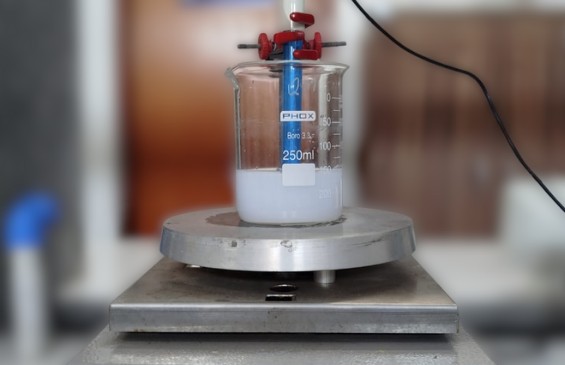
The present research aimed to synthesize the tin dioxide (SnO2) semiconductor by coprecipitation at room temperature, a chemical synthesis method widely used to obtain nanomaterials. After the synthesis, the SnO2 was structurally characterized by X-ray diffraction, Rietveld refinement, micro-Raman spectroscopy and Fourier transform infrared spectroscopy. These structural techniques revealed the formation of a highly disordered tetragonal rutile structure, without the presence of secondary phases and impurities. The band gap energy was calculated from UV-vis diffuse reflectance spectroscopy, showing a reduced value (3.17 eV) when compared to the literature. Furthermore, the shape and size of the nanoparticles were investigated by field emission scanning electron microscopy and transmission electron microscopy, obtaining irregular spherical nanoparticles with an average size of approximately 25 nm, together with microrod-like structures. Therefore, it was possible to develop a simple and effective synthetic route to control the band gap of SnO2 nanoparticles.
References
Aliahmad, M.; Dehbashi, M. Ni-doped SnO2 Nanoparticles synthesized by chemical co-precipitation method. Iranica Journal of Energy & Environment, v. 4, n. 1, p. 49-52, 2013.
https://doi.org/10.5829/idosi.ijee.2013.04.01.08
Amutha, A. Structural and FTIR studies of pure and zinc doped SnO2 nanoparticles. Advances in Materials Science and Engineering: An International Journal (MSEJ), v. 9, n. 1/2/3, p. 1-8, 2022.
https://doi.org/10.5121/msej.2022.9301
Callister Jr, W. D. Ciência e engenharia de materiais: uma introdução. 8 ed. Rio de Janeiro: LTC, 844p. 2012.
Du, B.; He, K.; Tian, G.; Chea, X.; Song, L. Robust electron transport layer of SnO2 for efficient perovskite solar cells: recent advances and perspectives. Journal of Materials Chemistry C, v. 11, p. 13625-13646, 2023. https://doi.org/10.1039/D3TC02445H
Guan, X.; Wang, Y.; Luo, P.; Yu, Y.; Chen, D.; Li, X. Incor-porating N atoms into SnO2 nanostructure as an approach to enhance gas sensing property for acetone. Nanomaterials, v. 9, n. 445, p. 1-18, 2019. https://doi.org/10.3390/nano9030445
Jarvin, M.; Inbanathan, S. S. R.; Rosaline, D. R.; Prabha, A. J.; Dhas, S. M. B. A study of the structural, morphological, and optical properties of shock treated SnO2 nanoparticles: removal of victoria blue dye. Heliyon, v. 8, n. 6, 2022. https://doi.org/10.1016/j.heliyon.2022.e09653
Kar, A.; Olszowka, J.; Sain, S.; Sloman, S. R. I.; Montes, O.; Fernandez, A.; Pradhan, S. K.; Wheatley, A. E. Morpholog-ical effects on the photocatalytic properties of SnO2 nanostructures. Journal of Alloys and Compounds, v. 810, p. 151718, 2019.
Karmaoui, M.; Jorge, A. B.; McMillan, P. F.; Aliev, A. E.; Pullar, R. C.; Labrincha, J. A.; Tobaldi, D. M. One-step synthesis, structure, and band gap properties of SnO2 nano-particles made by a low temperature nonaqueous sol–gel technique. ACS Omega, v. 3, n. 10, p. 13227-13238, 2018. https://doi.org/10.1021/acsomega.8b02122
Korjenic, A.; Raja, K. S. Electrochemical stability of fluorine doped tin oxide (FTO) coating at different pH conditions. Journal of The Electrochemical Society, v. 166, n. 6, p. C169-C184, 2019.
https://doi.org/10.1149/2.0421906jes
Kumar, V.; Singh, K.; Kumar, A.; Kumar, M.; Singh, K.; Vij, A.; Thakur, A. Effect of solvent on crystallographic, mor-phological
Downloads
Published
How to Cite
Issue
Section
License
Copyright (c) 2025 Gleice Botelho, Raissa Santos Sousa

This work is licensed under a Creative Commons Attribution 4.0 International License.
Copyright (c) 2024 - Journal of Biotechnology and Biodiversity

This work is licensed under a Creative Commons Attribution 4.0 International License.
Authors who publish with this journal agree to the following terms:
Authors retain copyright and grant the journal right of first publication with the work simultaneously licensed under a Creative Commons Attribution License (CC BY 4.0 at http://creativecommons.org/licenses/by/4.0/) that allows others to share the work with an acknowledgement of the work's authorship and initial publication in this journal.
Authors are able to enter into separate, additional contractual arrangements for the non-exclusive distribution of the journal's published version of the work (e.g., post it to an institutional repository or publish it in a book), with an acknowledgement of its initial publication in this journal.
Authors are permitted and encouraged to post their work online (e.g. in institutional repositories or on their website) prior to and during the submission process, as it can lead to productive exchanges, as well as earlier and greater citation of published work (Available at The Effect of Open Access, at http://opcit.eprints.org/oacitation-biblio.html).