Hydric stress index of sunflower irrigated with water replacement fractions and magnetically altered water
DOI:
https://doi.org/10.20873/jbb.uft.cemaf.v14n1.20738Palabras clave:
Helianthus annuus L., water stress, magnetic fieldResumen
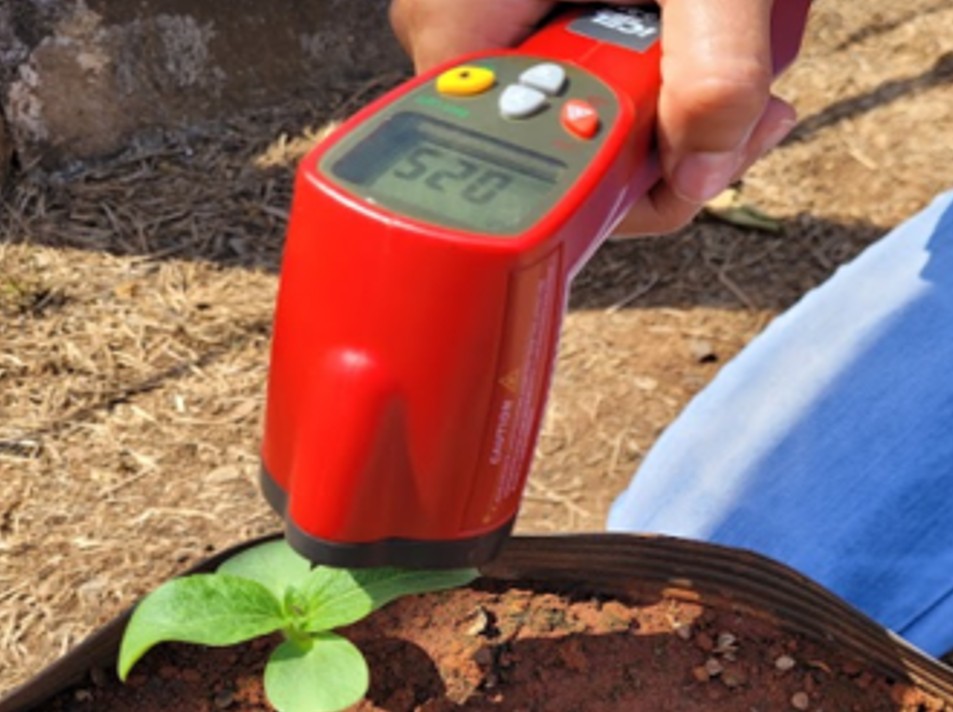
The objective was to evaluate the water sensitivity of sunflower (Helianthus annuus L.) using the crop water stress index (WSI) and leaf area (AF), when subjected to soil water variation and using normal and magnetized water in irrigation. The experiment was conducted in pots with cv BRS 323 grown in red latosol. The design was randomized blocks (DBC) in a 4 x 2 x 4 factorial scheme with 4 replications, with 4 water replacement fractions (100, 75, 50, 25% - RH); 2 types of irrigation water (normal and magnetized) and 4 evaluation periods (20, 40, 60 and 80 days after emergence - DAE). The magnetization occurred through the Sylocimol magnetizer constantly deposited in a different reservoir and the RHs were administered with the fractions of the crop's real evapotranspiration (ETrc) obtained by the water balance. In calculating the WSI, the air temperature was measured using a maximum and minimum thermometer and the leaf temperature was measured using a digital infrared thermometer. FA was calculated indirectly after measuring leaf lengths. Magnetized water reduced AF and increased WSI. Greater plant hydration reduced WSI, regardless of the type of water. The highest WSI occurred at HRs of 25% and 50% at 68 and 84 DAE, respectively. The maximum AF is only obtained at a RH of 127.5%, that is, outside the water range imposed in the study, resulting from its quality.
Citas
Alderfasi AA, Al-Suhaibani NA, Selim MM, Al-Hammad BAA. Using Magnetic Technologies in Management of Wa-ter Irrigation Programs under Arid and Semi-Arid Ecosys-tem. v. 3, n. 4, p. 109-116, 2016.
Amaral AM, Teixeira MB, Soares FA, Santos MACM, Bas-tos FJC, Farias AM. Influência de diferentes níveis de repo-sição hídrica, salinidade e adubação nitrogenada no girassol. Meio Ambiente (Brasil), v. 2, n. 4, p. 18-31, 2020. https://doi.org/10.5281/zenodo.4007173
Azevedo, M. R. Q. A., Medeiros, J. F., Bezerra, M. A., Oli-veira, F. R. A., & Gheyi, H. R.. Efeitos da salinidade na ab-sorção de água e nutrientes pelas plantas. Revista Brasileira de Engenharia Agrícola e Ambiental, v. 22, n.1, p. 3-10, 2022.
https://doi.org/10.1590/1807-1929/agriambi.v22n1p3-10
Carvalho EOT, Costa DLP, Vieira ICO, Ferreira BG, Nunes HGGC, Souza PJOP. Crop water stress index of cowpea under different water availability levels in Castanhal-PA. Revista Caatinga, v. 35, n. 3, p. 711-721, 2022. https://doi.org/10.1590/1983-21252022v35n322rc
Castiglioni VBR, Balla A, Castro C, Silveira JM. Fases de desenvolvimento da planta de girassol. 2. ed. Londrina: Em-brapa-CNPSo. 1997.
Dastorani M, Albaji M, Nasab SB. Crop response and water productivity of sunflower (Helianthus annuus L.) drip-irrigated with magnetically treated and non-magnetically treated water with variable salinity. Water SA, v. 48, n.1, p. 90-96, 2022.
Embrapa - Empresa Brasileira de Pesquisa Agropecuária. Informes da avaliação de genótipos de girassol 2021/2022 e 2022 [Internet]: Embrapa Soja 2022. [citado em 12 dez 2023]. Disponível em:
Generoso TN, Martinez, MA, Rocha GC, Hamakawa PJ. Water magnetization and phosphorus transport parameters in the soil. Revista Brasileira de Engenharia Agrícola e Ambi-ental. v. 21, n.1, p. 9-13,
https://doi.org/10.1590/1807-1929/agriambi.v21n1p9-13
Gheyi HR, Dias NS, Lacerda CF, Gomes Filho E. Manejo da salinidade na agricultura: Estudos básicos e aplicados. 2. ed. Fortaleza:INCTSal. 2016
Gomes FFL, Lima JS, Pinheiro Neto, LG. Aplicações da termografia na agricultura. Agrarian Academy. v. 8, n. 16, p. 91-105, 2021.
https://doi.org/ 10.18677/Agrarian_Academy_2021B9
Hussain M, Farooq S, Hasan W, Ul-Allah S, Tanveer M, Farooq M, Nawaz A. Drought stress in sunflower: Physio-logical effects and its management through breeding and ag-ronomic alternatives. Agricultural Water Management. v. 201, n. 31, p.152-166, 2018. https://doi.org/10.1016/j.agwat.2018.01.028
Lopes NF, Lima MGS. Fisiologia da produção. Viçosa: UFV, 492 p. 2015.
Mahmoud M., Ismail, S. M., El-Monem A., Darwish M. Magnetically treated brackish water new approach for miti-gation salinity stress on sunflower productivity and soil properties under South Sinai region, Egypt. Alexandria Sci-ence Exchange Journal, v. 40, n. 3, p. 451-470, 2019.
Maia Júnior SO, Guerra HOC, Andrade JR, Araújo DL, Chaves LHG, Suassuna JF. Crescimento, desenvolvimento e produção de três cultivares de girassol sob diferentes re-gimes hídricos. Revista de Ciências Agrárias. v. 58, n.2, p. 124-131, 2016.
https://doi.org/ 10.4322/rca.2156
Maldaner IC, Heldwein AB, Loose LH, Lucas DDP, Guse FI, Bertoluzzi MP. Modelos de determinação não-destrutiva da área foliar em girassol. Ciência Rural. v. 39, n.5, p. 1356-1361, 2009.
https://doi.org/10.1590/S0103-84782009000500008
Mendes BTT, Gomes Filho A, Soares DP, Silva, LAG, Oli-veira SL, Leandro RI. Exigência térmica de diferentes genó-tipos de girassol cultivados na região norte de Minas Gerais. Multifaces. v. 1, n. 2, p.38-52, https://doi.org/10.29327/2169333.1.2-1
Mendes JPP, Amaral AM, Verssiani MAS, Santos MÂCM. Crescimento e qualidade de mudas de baru em reposta a hi-droretentor e água magnetizada. Scientia Plena. v. 16, n.11, p. 1-10, 2020. https://doi.org/10.14808/sci.plena.2020.110201
Novais RF, Neves JCL, Barros, NF. Ensaio em ambiente controlado. In: Oliveira AJ. Métodos de pesquisa em fertili-dade do solo. Embrapa, p.189-253. 1991.
Oliveira FG, Ferreira PA, Santos DBD, Garcia GDO. Índice diário de estresse hídrico do feijoeiro irrigado com água sa-lina. Revista Brasileira de Engenharia Agrícola e Ambiental, v. 9, n.1, p. 6-10, 2021.
Pizetta SC, Deus FP, Paiva PDO, Diotto AV, Thebaldi MS, Colodetti TV, Oliveira JF, Vieira NPA, Jaeggi MEPC. Leaf nutrient content of ornamental sunflowers subjected to different irrigation depths with magnetized water. Journal of Plant Nutrition, v.46, n.16, p. 3969-3982, 2023.
Selin DAFH, Nassar RMA, Boghdady MS, Bonfill M. Phys-iological and anatomical studies of two wheat cultivars irri-gated with magnetic water under drought stress condi-tions. Plant physiology and biochemistry, v.135, p. 480-488, 2019. https://doi.org/
Silva TRG, Costa MLA, Farias LRA, Santos MA, Rocha JJL, Silva JV. Fatores abióticos no crescimento e florescimento das plantas. Research, Society and Development. v. 10, n.4, p. 1-9, 2021.
https://doi.org/10.33448/rsd-v10i4.13817
Taiz L, Zeiger E. Fisiologia Vegetal. 3 ed. São Paulo: Artmed, XXXp. 2006.
Turco JEP, Furlani CEA, Oliveira JLP, Cardoso JRF. Mo-mento de irrigar a grama batatais utilizando índices de es-tresse hídrico. Irriga, v. 27, n.3, p.557-566, 2022. https://doi.org/10.15809/irriga.2022v27n3p557-566
Verssiani MAS, Amaral AM, Mendes JPP, Botelho LSB, Santos, MAC. M. Influência da irrigação com água magne-tizada no cultivo de pimenteiras do genêro Capsicum. Meio Ambiente (Brasil), v.3, n.5, p. XX-XX, 2021. https://doi.org/10.5281/zenodo.5684031
Zarian N, Fotouhi F, Afrous A. The effects water stress, magnetic and moisture pretreatment on physiological param-eters and yield and harvest index of sunflower in north of Khuzestan climate condition. Water Engineering, v.7, n. 2, 150-154, 2019.
Descargas
Publicado
Cómo citar
Número
Sección
Licencia
Derechos de autor 2026 Alisson Macendo Amaral, Eliete Aparecida Graciano Gonçalves, Maria Ângela Cruz Macêdo dos Santos, Adriana Magalhães Farias, Ana Flávia Cordeiro de Brito, Lorene Alves de Oliveira

Esta obra está bajo una licencia internacional Creative Commons Atribución 4.0.
Copyright (c) 2024 - Journal of Biotechnology and Biodiversity

Esta obra está bajo una Licencia Creative Commons Atribución 4.0 Internacional.
Los autores que publican en esta revista aceptan los siguientes términos:
Los autores mantienen los derechos autorales y conceden a la revista el derecho de primera publicación, con el trabajo simultáneamente licenciado bajo la LicenciaCreative Commons Attribution (CC BY 4.0 en el link http://creativecommons.org/licenses/by/4.0/) que permite compartir el trabajo con reconocimiento de la autoría y publicación inicial en esta revista.
Los autores tienen autorización para asumir contratos adicionales separadamente, para distribución no exclusiva de la versión del trabajo publicado en esta revista (ej.: publicar en repositorio institucional o como capítulo de libro), con reconocimiento de autoría y publicación inicial en esta revista.
A los autores se les permite, y son estimulados, a publicar y distribuir su trabajo online (ej.: en repositorios institucionales o en su página personal) en cualquier punto antes o durante el proceso editorial, ya que esto puede generar alteraciones productivas, bien como aumentar el impacto y la citación del trabajo publicado (disponible en El Efecto del Acceso Libre en el link http://opcit.eprints.org/oacitation-biblio.html).