The effects of different irrigation frequencies in morphological responses of Talinum paniculatum (Jacq.) Gaertn.
DOI:
https://doi.org/10.20873/jbb.uft.cemaf.v14n3.19515Palabras clave:
growth, water availability, stomata, irrigation frequenciesResumen
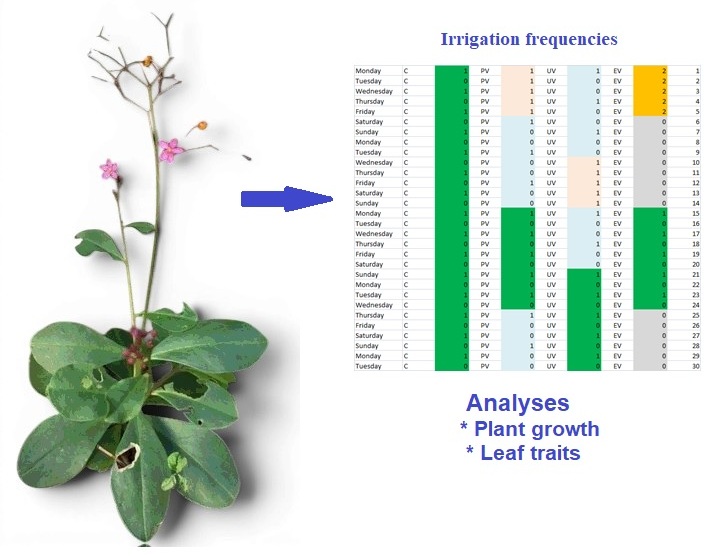
Water is essential for plant survival and understanding plant acclimatization to irrigation variations is necessary considering global climate change. However, few studies relate plant responses to variations in irrigation frequency. Therefore, we tested the influence of four irrigation treatments in Talinum paniculatum (Jacq.) Gaertn, an edible tropical plant: constant (C), predictable variable (PV), unpredictable variable (UV) and extremely variable (EV), keeping the same number of irrigation events for all treatments at the end of the experiment. Root and shoot length, root/shoot ratio, root, shoot and leaf fresh and dry mass, leaf number, stomatal density, stomatal guard cells length and stomatal area index were measured. T. paniculatum plants that received higher irrigation frequencies (C and PV treatments) showed greater growth. Plants in the EV treatment exhibited reduced growth, with shorter shoot length, lower fresh and dry weight of shoots, and a lower number of leaves, compared to the C and PV treatments. However, plants in the EV treatment had a higher root/shoot ratio, indicating greater biomass allocation to the root system, suggesting a strategy to increase water uptake efficiency and increase survival rates under drought stress. Some traits did not differ between treatments, such as root length, guard cell length, and stomatal density, which may be because T. paniculatum is a facultative CAM plant. Thus, T. paniculatum responds to changes in irrigation frequency and evaluating the responses of tropical plants to different precipitation frequencies can favor our prediction of vegetation responses considering current precipitation changes.
Citas
Allan RP, Soden, BJ. Atmospheric warming and the amplifi-cation of precipitation extremes. Science, v. 321, n. 5895, p. 1481-1484, 2008. https://doi.org/10.1126/science.1160787
Anderegg WRL. Spatial and temporal variation in plant hy-draulic traits and their relevance for climate change impacts on vegetation. New Phytologist, v. 205, n. 3, p. 1008-1014, 2015. https://doi.org/10.1111/nph.12907
Aparecido, LEO et al. Köppen, Thornthwaite and Camargo climate classifications for climatic zoning in the State of Pa-raná, Brazil. Ciência e Agrotecnologia, v. 40, p. 405-417, 2016.
Bertolino LT, Caine RS, Gray JE. Impact of stomatal density and morphology on water-use efficiency in a changing world. Frontiers in plant science, v. 10, p. 225, 2019. https://doi.org/10.3389/fpls.2019.00225
Biondo E, Fleck M, Kolchinski EM, Sant’Anna V, Polesi RG. Diversidade e potencial de utilização de plantas alimentícias não convencionais no Vale do Taquari, RS. Revista Eletrô-nica Científica da UERGS, v. 4, n. 1, p. 61-90, 2018.
Bjorkman AD. et al. Plant functional trait change across a warming tundra biome. Nature, v. 562, n. 7725, p. 57-62, 2018.
https://doi.org/10.1038/s41586-018-0563-7
Borrajo CI, Sánchez-Moreiras, AM, Reigosa, MJ. Morpho-physiological responses of tall wheatgrass populations to different levels of water stress. PloSone, v. 13, n. 12, p. e0209281, 2018.
Broennimann O, Thuiller W, Hughes G, Midgley GF, Alkemade JMR, Guisan A. Do geographic distribution, niche property and life form explain plants' vulnerability to global change?. Global Change Biology, v. 12, n. 6, p. 1079-1093, 2006.
https://doi.org/10.1111/j.1365-2486.2006.01157.x
Castro CM, Devide ACP. Plantas alimentícias não-convencionais: sazonalidade no Vale do Paraíba. Pindamo-nhangaba: Agência Paulista de Tecnologia dos Agronegó-cios, 2013. 66p
Correia, MJ, Coelho, D, David, MM. Response to seasonal drought in three cultivars of Ceratonia siliqua: leaf growth and water relations. Tree Physiology, v. 21, n. 10, p. 645-653, 2001.
Dalal A, Attia Z,MoshelionM. To produce or to survive: how plastic is your crop stress physiology?. Frontiers in plant science, v. 8, p. 2067, 2017. https://doi.org/10.3389/fpls.2017.02067
Davatgar N, Neishabouri MR, Sepaskhah AR, Soltani A. Physiological and morphological responses of rice (Oryza sativa L.) to varying water stress management strate-gies. International Journal of Plant Production,v.3, p. 19-32, 2009.
https://doi.org/10.22069/IJPP.2012.660
Fang Y et al. Moderate drought stress affected root growth and grain yield in old, modern and newly released cultivars of winter wheat. Frontiers in Plant Science, v. 8, p. 672, 2017.
https://doi.org/10.3389/fpls.2017.00672
Felton AJ, Knapp AK, Smith MD. Precipitation–productivity relationships and the duration of precipitation anomalies: an underappreciated dimension of climate change. Global Change Biology, v. 27, n. 6, p. 1127-1140, 2021.
https://doi.org/10.1111/gcb.15480
Güerere I, Tezara W, Herrera C, Fernández MD.Recycling of CO2 during induction of CAM by drought in Talinum pa-niculatum (Portulacaceae). Physiologia Plantarum, v. 98, n. 3, p. 471-476, 1996.
Herrera A. Crassulacean acid metabolism and fitness under water deficit stress: if not for carbon gain, what is facultative CAM good for?. Annals of botany, v. 103, n. 4, p. 645-653, 2009.
https://doi.org/10.1093/aob/mcn145
Husen A, Iqbal M, Aref I. M. Plant growth and foliar charac-teristics of faba bean (Vicia faba L.) as affected by indole-acetic acid under water-sufficient and water-deficient condi-tions. Journal of Environmental Biology, v. 38, n. 2, p. 179, 2017.
https://doi.org/10.22438/jeb/38/2/MS-247
Jensen NB, Vrobel O, Nageshbabu NA, Diego ND, Tarkow-ski P, Ottosen C-O, Zhou R. Stomatal effects and ABA me-tabolism mediate differential regulation of leaf and flower cooling in tomato cultivars exposed to heat and drought stress. Journal of Experimental Botany, v. 75, n. 7 p. 2156–2175, 2024.
https://doi.org/10.1093/jxb/erad498
Kim J-S, Kidokoro S, Yamaguchi-Shinozaki K, Shinozaki K. Regulatory networks in plant responses to drought and cold stress. Plant Physiology, v. 195, p. 170–189, 2024.
Kinupp VF, Lorenzi H. Plantas Alimentícias Não Convencio-nais (PANCs) no Brasil: guia de identificação, aspectos nu-tricionais e receitas ilustradas. São Paulo: Instituto Planta-rum. 2014; 768p.
Knapp, AK. et al. Characterizing differences in precipitation regimes of extreme wet and dry years: implications for cli-mate change experiments. Global change biology, v. 21, n. 7, p. 2624-2633, 2015.
https://doi.org/10.1111/gcb.12888
Liu W, Xie F, Chen Y, Cui G. Growth and Morphological Responses of Kentucky Bluegrass to Homogeneous and Heterogeneous Soil Water Availabilities. Agronomy, v. 12, n. 6, p. 1265, 2022.
Ma Y, Zhang Y, Xu J, Qi J, Liu X, Guo L, Zhang H. Re-search on the Mechanisms of Phytohormone Signaling in Regulating Root Development. Plants, v. 13, p. 3051-3066, 2024.
https://doi.org/10.3390/plants13213051
Memmott J, Craze PG, Waser NM. Global warming and the disruption of plant–pollinator interactions. Ecology letters, v. 10, n. 8, p. 710-717, 2007.
https://doi.org/10.1111/j.1461-0248.2007.01061.x
Moler ERV, Kolb T, Brady A, Palmiero BN, Wallace TR, Waring KM, Whipple AV. Plant developmental stage influ-ences responses of Pinus strobiformis seedlings to experi-mental warming. Plant‐Environment Interactions, v. 2, n. 3, p. 148-164, 2021.
https://doi.org/10.1002/pei3.10055
Mondoni A, Rossi G, Orsenigo S, Probert RJ. Climate warm-ing could shift the timing of seed germination in alpine plants. Annals of Botany, v. 110, n. 1, p. 155-164, 2012. https://doi.org/10.1093/aob/mcs097
Moura IO et al. Chemical characterization, antioxidant activity and cytotoxicity of the unconventional food plants: sweet potato (Ipomoea batatas (L.) Lam.) leaf, major gomes (Talinum paniculatum (Jacq.) Gaertn.) and caruru (Amaran-thus deflexus L.). Waste and Biomass Valorization, v. 12, n. 5, p. 2407-2431, 2021.
https://doi.org/10.1007/s12649-020-01186-z
Osakabe Y, Osakabe K, Shinozaki K, Tran L-SP. Response of plants to water stress. Frontiers in plant science, v. 5, p. 86, 2014.
https://doi.org/10.3389/fpls.2014.00086
Prince SJ, Murphy M, Mutava RN, Durnell LA, Valliyodan B., Shannon JG, Nguyen HT. Root xylem plasticity to im-prove water use and yield in water-stressed soy-bean. Journal of experimental botany, v. 68, n. 8, p. 2027-2036, 2017.
https://doi.org/10.1093/jxb/erw472
Riederer M, Schreiber L. Protecting against water loss: analy-sis of the barrier properties of plant cuticles. Journal of ex-perimental botany, v. 52, n. 363, p. 2023-2032, 2001. https://doi.org/10.1093/jexbot/52.363.2023
Shao H-B, Chu L-Y, Jaleel, CA, Zhao C-X. Water-deficit stress-induced anatomical changes in higher plants. Comptesrendusbiologies, v. 331, n. 3, p. 215-225, 2008.
https://doi.org/10.1016/j.crvi.2008.01.002
Scheiner SM. Selection experiments and the study of pheno-typic plasticity. Journal of Evolutionay Biology, v. 15, p. 889-898, 2002.
Taura HM, Laroca S, Barbosa JF, Rodrigues J. Melissocenó-tica (Apoidea, Anthophila) no Parque Florestal dos Pionei-ros, Maringá, PR (sul do Brasil): Parte II. Utilização de re-cursos florais. Acta Biológica Paranaense, v. 36, n. 3-4, p. 175-192. 2007
Thanamool C, Papirom P, Chanlun S, Kupittayanant S. Tali-num paniculatum (Jacq.) Gertn: a medicinal plant with po-tential estrogenic activity in ovariectomized rats. International Journal of Pharmacy and Pharmaceutical Sciences, v. 5, n. 2, p. 478-485, 2013.
Trenberth KE, Dai A, Schrier G van der, Jones PD, Barichiv-ich J, Briffa KR, Sheffield J. Global warming and changes in drought. Nature Climate Change, v. 4, n. 1, p. 17-22, 2014.
https://doi.org/10.1038/nclimate2067
Valerio R, Ramirez N. Depresión Exogámica y Biología re-productiva de Talinum paniculatum (Jacq.) Gaertner (Portu-lacaceae). Acta Botánica Venezuelica, v.26, n.2, p.111-124, 2003.
Valladares, F. A mechanistic view of the capacity of forests to cope with climate change. In: Managing forest ecosystems: the challenge of climate change. Springer, Cham, 2017. p. 15-40.
https://doi.org/10.1007/978-1-4020-8343-3_2
Varol T, Canturk U, Cetin M, Ozel HB, Sevik H. Impacts of climate change scenarios on European ash tree (Fraxinus excelsior L.) in Turkey. Forest Ecology and Management, v. 491, p. 119199, 2021. https://doi.org/10.1016/j.foreco.2021.119199
Varol T, Cetin M, Ozel HB, Sevik H, Cetin IZ. The effects of climate change scenarios on Carpinus betulus and Carpinus orientalis in Europe. Water, Air, & Soil Pollution, v. 233, n. 2, p. 1-13, 2022.
https://doi.org/10.1007/s11270-022-05516-w
Wang, JH, Chen W, Ma, RJ, Baskin CC, Baskin JM, Qi W, Chen XL. Role of short-term cold stratification on seed dormancy break and germination of alien species in south-eastern China. Plant Ecology, v. 217, n. 4, p. 383-392, 2016.
Wu, J, Wang, J, Hui W, Zhao F, Wang P, Su C, Gong W. Physiology of Plant Responses toWater Stress and Related Genes: A Review. Forests, v. 13, p. 324-339, 2022. https://doi.org/10.3390/f13020324
Yan S, Weng B, Jing L, Bi, W, Yan D. Adaptive pathway of summer maize under drought stress:Transformation of root morphology and water absorption law. Front. Earth Sci., v. 10, p.1020553, 2022.
doi: 10.3389/feart.2022.1020553
Zeppel, MJB,Wilks JV, Lewis JD. Impacts of extreme precipi-tation and seasonal changes in precipitation on plants. Biogeosciences, v. 11, n. 11, p. 3083-3093, 2014.
Descargas
Publicado
Cómo citar
Número
Sección
Licencia
Derechos de autor 2026 Kariny Cari Nascimento, Lindamir Pastorini

Esta obra está bajo una licencia internacional Creative Commons Atribución 4.0.
Copyright (c) 2024 - Journal of Biotechnology and Biodiversity

Esta obra está bajo una Licencia Creative Commons Atribución 4.0 Internacional.
Los autores que publican en esta revista aceptan los siguientes términos:
Los autores mantienen los derechos autorales y conceden a la revista el derecho de primera publicación, con el trabajo simultáneamente licenciado bajo la LicenciaCreative Commons Attribution (CC BY 4.0 en el link http://creativecommons.org/licenses/by/4.0/) que permite compartir el trabajo con reconocimiento de la autoría y publicación inicial en esta revista.
Los autores tienen autorización para asumir contratos adicionales separadamente, para distribución no exclusiva de la versión del trabajo publicado en esta revista (ej.: publicar en repositorio institucional o como capítulo de libro), con reconocimiento de autoría y publicación inicial en esta revista.
A los autores se les permite, y son estimulados, a publicar y distribuir su trabajo online (ej.: en repositorios institucionales o en su página personal) en cualquier punto antes o durante el proceso editorial, ya que esto puede generar alteraciones productivas, bien como aumentar el impacto y la citación del trabajo publicado (disponible en El Efecto del Acceso Libre en el link http://opcit.eprints.org/oacitation-biblio.html).