Antioxidant chondroitin sulfate extracted from Nile tilapia (Oreochromis niloticus) gill basis
DOI:
https://doi.org/10.20873/jbb.uft.cemaf.v14n3.21984Keywords:
waste, glycan, structural composition, oxidative stressAbstract
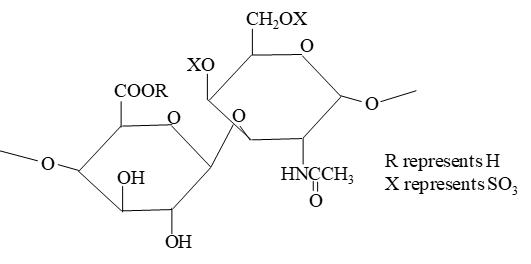
Gill anatomy of Oreochromis niloticus contains sulfated glycosaminoglycans (GAGs), but their antioxidant potentials are unknown. This study partially examined gill (arches/bases) GAGs and analyzed as in vitro oxidative inhibitors. Papain-digested arches/bases relatively differed in yield of GAGs (1.27 ± 0.03 vs. 0.45 ± 0.03%, P<0.05), with distinct charge composition between condroitin-6/4-sulfate (CS) chains of ~40 kDa analyzed by combination of agarose/polyacrylamide electrophoreses using known markers revealed in toluidine blue or stains-all; and analysis by infrared spectroscopy. Antioxidant assays were tested for gill basis GAGs that potentially inhibited the DPPH radical similar to commercial synthetic (93.14 ± 0.38 vs. 95.68 ± 0.028% inhibition at 4 mg mL-1, P > 0.05), whereas for total antioxidant capacity and ferrous ion chelanging showed more reduced actions than the controls at same amount of sample (<10/80% inhibition, respectively, P < 0.05). The residual sugar composition in terms of carboxylated (uronic acid) and sulfated groups in CS structure suggested specific active sites on the reducing potencial of the initiation/propagation processes. Therefore, CS from O. niloticus gill bases reveals to be a promissing antioxidant canditate from cartilage by-product.
References
Andrade JPS, Oliveira CP, Tovar AMF, Mourão PAS, Vila-nova E. A color-code for glycosaminoglycans identification by means of polyacrylamide gel electrophoresis stained with the cationic carbocyanine dye Stains-All. Electrophoresis, v. 39, n. 4, p. 666-669, 2017.
https://doi.org/10.1002/elps.201700391
Badri A, Williams A, Linhardt RJ, Koffas MA. The road to animal free glycosaminoglycan production: current efforts and bottlenecks. Current Opinion in Biotechnology, v. 53, p. 85-92, 2018.
https://doi.org/10.1016/j.copbio.2017.12.018
Bai M, Han W, Zhao X, Wang Q, Gao Y, Deng S. Glycosa-minoglycans from a sea snake (Lapemis curtus): Extraction, structural characterization and antioxidant activity. Marine Drugs, v. 16, n. 5, 170, 2018.
https://doi.org/10.3390/md16050170
Baldisserotto B. Fisiologia de peixes aplicada à piscicultura. Santa Maria: Ed. UFSM, 212p. 2002.
Cooney R, Sousa DB, Fernandez-Rios AF, Mellett S, Rowane N, Morse AP et al. A circular economy framework for sea-food waste valorisation to meet challenges and opportunities for intensive production and sustainability. Journal of Cleaner Production, v. 392, p. 136283, 2023.
https://doi.org/10.1016/j.jclepro.2023.136283
Couto MR, Rodrigues, JL, Rodrigues LR. Heterologous production of chondroitin. Biotechnology Reports, v. 33, e00710, 2022.
https://doi.org/10.1016/j.btre.2022.e00710
Dietrich CP, Dietrich SMC. Electrophoretic behaviour of acidic mucopolysaccharides in diamine buffers. Analytical Biochemistry, v. 70, n. 2, p. 645-647, 1976. https://doi.org/ 10.1016/0003-2697(76)90496-6
Farndale RW, Buttle DJ, Barrett AJ. Improved quantitation and discrimination of sulphated glycosaminoglycans by use of dimethylmethylene blue. Biochimica et Biophysica Ac-ta, v. 883, n. 2, p. 173-177, 1986.
https://doi.org/10.1016/0304-4165(86)90306-5
Fernandes FGM, Rodrigues JAG, Santiago LM, Queiroz INLQ, Feitosa JPM, Soares AS et al. Biochemical prospec-tion of glycosaminoglycans in fish wastes aiming at circular economy. Revista Brasileira de Engenharia de Pesca, v. 16, n. 3, p. 18-33, 2025.
https://doi.org/10.18817/repesca.v16i3.4116
Garnjanagoonchorn W, Wongekalaka L, Engkagulb A. De-termination of chondroitin sulfate from different sources of cartilage. Chemical Engineering and Processing, v. 46, n. 5, p. 465-471, 2007.
https://doi.org/10.1016/j.cep.2006.05.019
Koll R, Hauten E, Theilen J, Bang C, Bouchard M, Thiel R et al. Spatio-temporal plasticity of gill microbiota in estuarine fish. Science of the Total Environment, v. 957, 177505, 2024.
https://doi.org/10.1016/j.scitotenv.2024.177505
Jridi M, Nasri R, Marzougui, Z, Abdelhedi O, Hamdi M, Nasri M. Characterization and assessment of antioxidant and antibacterial activities of sulfated polysaccharides extracted from cuttlefish skin and muscle. International Journal of Biological Macromolecules, v. 123, p. 1221-1228, 2019.
https://doi.org/10.1016/j.ijbiomac.2018.11.170
Li W, Ura K, Takagi Y. Industrial application of fish cartilagi-nous tissues. Current Research in Food Science, v. 5, p. 698-709, 2022.
https://doi.org/10.1016/j.crfs.2022.04.001
Lima ACN, Rodrigues JAG, Cavalcante LA, Feitosa JPM, Soares AS, Neto OPP. Combined fractionation for chon-droitin sulfate-selective characterization from Oreochromis niloticus gills. Revista Brasileira de Engenharia de Pesca. v. 16, n. 3, p. 34-48, p. 2025.
https://10.18817/repesca.v16i3.4073
Machado TM, Catapreta LC, Furlan EF, Neiva, CRP. Econo-mia circular e resíduo de pescado. Revista Brasileira de Ciências Ambientais, v. 55, n. 4, p. 525-535, 2020. https://doi.org/10.5327/Z2176-947820200677
Marques DF, Neto OPP, Cordeiro W, Costa MP, Vanderley-Salmito CSB. Ultrafine bubble generator for oxygenation of Nile tilapia (Oreochromis niloticus) breeding tanks under recirculating water system. Acta Veterinaria Brasilica, v. 17, n. 2, p. 91-98, 2023. https://doi.org/10.21708/avb.2023.17.2.11242
Medeiros LHC, Vasconcelos BMF, Silva MB, Souza-Junior AA, Chavante SH, Andrade GPV. Chondroitin sulfate from fish waste exhibits strong intracellular antioxidant potential. Brazilian Journal of Medical and Biological Research, v. 54, n. 10, e10730, 2021.
https://doi.org/10.1590/1414-431X2020e10730
Moreira HLM, Vargas L, Ribeiro RP, Zimmermann S. Fun-damentos da moderna aqüicultura. Canoas: Ulbra, 200p. 2001.
Nascimento RP, Pereira VA, Almeida-Monteiro PS, Sales YS, Araújo IWF, Rodrigues JAG et al. Use of glycosa-minoglycans from Oreochromis niloticus skin as an antiox-idant supplement for milt cryopreservation of Brazilian bo-cachico. Seminas: Ciências Agrárias, v. 42, n. 5, p. 2959, 2021.
https://doi.org/10.5433/1679-0359.2021v42n5p2959
Pomin VH, Mourão PAS. Structure, biology, evolution, and medical importance of sulfated fucans and galactans. Glyco-biology, v. 18, n. 12, p. 1016-1027, 2008.
https://doi.org/10.1093/glycob/cwn085
Regnault M, Durand F. Glycosaminglycans in gills of an intertidal grab (Carcinus maenas): changes in the gag popu-lation in response to prolonged air exposure. The Journal of Experimental Zoology, v. 281, n. 6, p. 554-564, 1998. https:// doi.org/10.1002/(SICI)1097-010X(19980815)281:6<554::AID-JEZ3>3.0.CO;2-M
Rodrigues JAG, Torres AB, Costa TO, Queiroz INL, Feitosa JPM, Soares AS et al. Antioxidant glycosaminoglycans ex-tracted from the skin of "tambatinga", a hybrid fish. Revista Brasileira de Engenharia de Pesca, v. 16, n. 3, p. 49-64, 2025.
https://doi.org/10.18817/repesca.v16i3.3711
Salles TC, Rodrigues JAG, Barcellos PG, Amaral GF, Araú-jo, IWF, Mourão PAS. Inhibition of thrombin generation by dermatan sulfate isolated from the skin of Oreochromis ni-loticus. Brazilian Journal of Agricultural Sciences, v. 12, n. 1, p. 98-104, 2017. https://doi.org/10.5039/agraria.v12i1a5412
Santiago LM, Rodrigues JAG, Queiroz INL, Costa TO, Feito-sa JPM, Soares SA et al. In vitro evaluation of antioxidant action of chondroitin sulfate from the gills of Prochilodus brevis. Revista Brasileira de Engenharia de Pesca, v. 15, n. 1, p. 08-20, 2024. https://doi.org/10.18817/repesca.v15i1.3619
Sundaresan G, Abraham RJJ, Rao VA, Babu RN, Govind V, Meti MF. Established method of chondroitin sulphate ex-traction from buffalo (Bubalus bubalis) cartilages and its identification by FTIR. Journal of Food Science and Technology, v. 55, n. 9, p. 3439-3445, 2018. https://doi.org/10.1007/s13197-018-3253-4
Volpi N. Anti-inflammatory activity of chondroitin sulphate: new functions from an old natural macromolecule. Inflam-mopharmacol, v. 19, n. 6, p. 299-306, 2011. https://doi.org/10.1007/s10787-011-0098-0
Wasserman L, Ber A, Allalouf D. Acidic glycosaminoglycans composition of the gills of Cyprinus carpio. Comparative Biochemistry and Physiology Part B, v. 42, n. 4, p. 669-677, 1972.
Downloads
Published
How to Cite
Issue
Section
License
Copyright (c) 2026 Francisca Geny Marfim Fernandes, José Ariévilo Gurgel Rodrigues, José Gabriel de Sousa Cândido, Ismael Nilo Lino de Queiroz, Johnny Peter Macedo Feitosa, Oscar Pacheco Passos Neto, Ianna Wivianne Fernandes de Araújo

This work is licensed under a Creative Commons Attribution 4.0 International License.
Copyright (c) 2024 - Journal of Biotechnology and Biodiversity

This work is licensed under a Creative Commons Attribution 4.0 International License.
Authors who publish with this journal agree to the following terms:
Authors retain copyright and grant the journal right of first publication with the work simultaneously licensed under a Creative Commons Attribution License (CC BY 4.0 at http://creativecommons.org/licenses/by/4.0/) that allows others to share the work with an acknowledgement of the work's authorship and initial publication in this journal.
Authors are able to enter into separate, additional contractual arrangements for the non-exclusive distribution of the journal's published version of the work (e.g., post it to an institutional repository or publish it in a book), with an acknowledgement of its initial publication in this journal.
Authors are permitted and encouraged to post their work online (e.g. in institutional repositories or on their website) prior to and during the submission process, as it can lead to productive exchanges, as well as earlier and greater citation of published work (Available at The Effect of Open Access, at http://opcit.eprints.org/oacitation-biblio.html).