Bromatology of potential aquatic macrophytes in the manatees diet in Marajó Bay, northern Brazil
DOI:
https://doi.org/10.20873/jbb.uft.cemaf.v13n2.19410Abstract
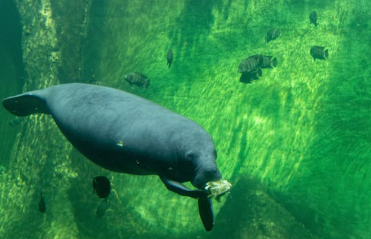
In Marajó Island, Brazil, there are two sympatric manatee species, which are vulnerable to extinction. These animals are casually found in soft drinks and fed until released. In this context, the present study investigated the nutritional and energetic composition of species of aquatic macrophytes that are potentially exploited as food sources by free-ranging manatees in Marajó Bay. Five species were selected for this study – Blutaparon portulacoides (A.St.-Hil.) Mears, Crenea maritima Aubl., Eleocharis geniculata (L.) Roem. & Schult., Fimbristylis sp., and Spartina alterniflora Loisel. Bromatological analyses were used to estimate dry matter (DM), mineral matter (MM), ether extract (EE), crude protein (CP), neutral detergent fiber (NDF), acid detergent fiber (ADF), non-fibrous carbohydrates (NFC), and gross energy (GE). In addition to having the highest protein content, E. geniculata also had the highest mean EE, indicating that it is the richest source of lipids of the five species analyzed. As B. portulacoides and C. maritima had the highest NFC content, they may be the richest sources of easily-digested carbohydrates. Spartina alterniflora had the highest NDF and ADF contents, indicating that it was the least digestible of the five plants, given that, the higher the ADF content of a food, the lower its digestibility. The results of this study provide important insights for the development of a balanced diet for captive manatees in rehabilitation, in particular growing infants.
References
Barbosa, P. D. S.; Silva, V. M, F.; Pereira-Junior, G. Tempo de passagem de duas dietas no trato gastrointestinal do pei-xe-boi da Amazônia Trichechus inunguis (Natterer, 1883) em cativeiro. Acta Amazonica, v. 43, n. 3, p. 365-370, 2013.
https://doi.org/10.1590/S0044-59672013000300012
Bertram, G. C. L.; Bertram, C. K. R. Manatees in the Guianas. Zoologica, v. 49, n. 2, p. 115-120, 1964. https://doi.org/10.5962/p.203296
Best, R. C. Food and feeding habits of wild and captive Sire-nia. Mammal Review, v. 1, n. 1, p. 3-29, 1981. https://doi.org/10.1111/j.1365-2907.1981.tb00243.x
Boyd, C. E. Fresh-Water Plants: A Potential Source of Pro-tein. Economic Botany, v. 22, n. 4, p. 359-368, 1968. https://doi.org/10.1007/BF02908132.
Burn, D. M. The digestive strategy and efficiency of the West Indian manatee, Trichechus manatus. Comparative Biochem-istry and Physiology Part A: Physiology, v. 85, n. 1, p. 139-142, 1986.
https://doi.org/10.1016/0300-9629(86)90475-5.
Dawes CJ. Seasonal proximate constituents and caloric values in seagrasses and algae on the West Coast of Florida. Jour-nal of Coastal Research, v. 2, n. 1, p. 25-32, 1986.
Dawes, C. J.; Chan, M.; Chinn, R.; Koch, E. W.; Lazar, A.; Tomasko, D. Proximate composition, photosynthetic and respiratory responses of the seagrass Halophila engelmannii from Florida. Aquatic Botany, v. 27, n. 2, p. 195-201, 1987.
https://doi.org/10.1016/0304-3770(87)90067-2
Detmann E, Souza MAD, Valadares-Filho SDC, Queiroz ACD, Berchielli TT, Saliba EDOS et al. Métodos para aná-lise de alimentos. Visconde do Rio Branco: Suprema, 214p. 2012.
Deutsch, C. J.; Self-Sullivan, C.; Mignucci-Giannoni, A. Trichechus manatus. A lista vermelha de espécies ameaçadas da IUCN 2008: e.T22103A9356917, 2008. https://dx.doi.org/10.2305/IUCN.UK.2008.RLTS.T22103A9356917.en.
Di Santo, L. G. Análise bromatológica das macrófitas aquáti-cas utilizadas como item alimentar na dieta de filhotes de peixes-boi amazônicos (Trichechus inunguis) em reabilita-ção. Ano de obtenção: 2013. Monografia (Graduação em Medicina Veterinária) – Universidade Estadual Paulista Jú-lio de Mesquita Filho, São Paulo.
Diretoria de Hidrografia e Navegação – DHN. Tábua das Marés. Marinha do Brasil. 2024. Disponível em: <https://www.marinha.mil.br/chm/tabuas-de-mare> Acessa-do em 06 de maio de 2024.
Durako, M. J.; Moffler, M. D. Spatial influences on temporal variations in leaf growth and chemical composition of Thalassia testudinum Banks ex König in Tampa Bay, Flori-da. Gulf and Caribbean Research, v. 8, n. 1, p. 43-49, 1985. https://doi.org/10.18785/grr.0801.07
França CF, Souza Filho PWM. Análise das mudanças morfo-lógicas costeiras de médio período na margem leste da Ilha de Marajó (PA) em imagem landsat. Revista Brasileira de Geociências, v. 33, n. suppl. 2, p. 127-136, 2003.
França, C. F. Compartimentação morfológica da margem leste da Ilha de Marajó: zona costeira dos municípios de Soure e Salvaterra. Estado do Pará. Revista Brasileira de Geomorfo-logia, v. 7, n. 1, p. 33-42, 2006. https://doi.org/10.20502/rbg.v7i1.58
Gallivan, G.; Best, R.; Kanwisher, J. Temperature regulation in the Amazonian manatee Trichechus inunguis. Physiological Zoology, v. 56, n. 2, p. 255-262, 1983. https://doi.org/10.1086/physzool.56.2.30156057.
Harshaw, L. T. Evaluation of the nutrition of Florida manatees (Trichechus manatus latirostris). Ano de obtenção: 2012. 192 p. Tese (Doutorado em Filosofia) – Universidade da Flórida, Flórida, USA.
Larkin, I. L.; Fowler, V. F.; Reep, R. L. Digesta passage rates in the Florida manatee (Trichechus manatus latirostris). Zoo biology, v. 26, n. 6, p. 503-515, 2007. https://doi.org/10.1002/zoo.20150.
Lemire, M. Particularites de l’estomac du lamantin Trichechus senegalensis Link. (Sireniens, Trichechidae). Mammalia, v. 32, n. 3, p. 475–520, 1968. https://doi.org/10.1515/mamm.1968.32.3.475
Lima DS, Emin-Lima R, Coutinho I, Romeiro S, Aranha L. Two Caribbean manatee calves rescued in coastal Amazonia. Sirenews, n. 60, p. 13-14, 2013.
Lins ALFA, Gurgel ESC, Bastos MNC, Sousa MEM, Emin-Lima R. Which aquatic plants of the intertidal zone do mana-tees of the Amazon estuary eat? Sirenews, n. 62, p. 11-12, 2014.
Macedo Júnior GL, Zanine AM, Borges I, Pérez JRO. Quali-dade da fibra para a dieta de ruminantes. Ciência Animal, v. 17, n. 1, p. 7-17, 2007.
Marmontel, M.; de Souza, D.; Kendall, S. Trichechus inun-guis. A lista vermelha de espécies ameaçadas da IUCN 2016: e.T22102A43793736, 2016. https://dx.doi.org/10.2305/IUCN.UK.2016-2.RLTS.T22102A43793736.en.
Mertens, D. Predicting intake and digestibility using mathe-matical models of ruminal function. Journal of animal sci-ence, v. 64, n. 5, p. 1548-1558, 1987. https://doi.org/10.2527/jas1987.6451548x
Oliveira, C. A. A.; Almeida, F. Q.; Vieira, A. A.; Lana, Â. M. Q.; Macedo, R.; Lopes, B. A.; Corassa, A. Cinética de pas-sagem da digesta, balanço hídrico e de nitrogênio em eqüi-nos consumindo dietas com diferentes proporções de volu-moso e concentrado. Revista Brasileira de Zootecnia, v. 32, n. 1, p. 140-149, 2003.
https://doi.org/10.1590/S1516-35982003000100018.
Rodrigues RC. Avaliação químico-bromatológica de alimentos produzidos em terras baixas para nutrição animal. Pelotas: Embrapa Clima Temperado, 31p. 2009.
Rodríguez-Chacón, Z. M. Caraterísticas alimentares e nutricio-nais do peixe-boi-da-Amazônia Trichechus inunguis (Mammalia, Sirenia), em condições de cativeiro. Ano de ob-tenção: 2001. 166 p. Tese (Doutorado em Ciências Biológi-cas) – Universidade do Amazonas, Manaus.
Siciliano S, Emin-Lima R, Sousa MEM, Soares JAB, Rodri-gues DP, Biancalana FSC. News from Omar, an orphaned manatee in rehabilitation in Marajó Island, Brazil north coast. Sirenews, n. 61, p. 4-5, 2014.
Siegal-Willott JL, Harr K, Hayek LAC, Scott KC, Gerlach T, Sirois P, Reuter M, Crewz DW, Hill RC. Proximate nutrient analyses of four species of submerged aquatic vegetation consumed by Florida manatee (Trichechus manatus latiros-tris) compared to romaine lettuce (Lactuca sativa var. longi-folia). Journal of Zoo and Wildlife Medicine, v. 41, n. 4, p. 594-602, 2010.
Sousa MEM et al. Learning with Omar: lessons from a semi-captive orphaned manatee and its environment on the east coast of Pará, Brazil. Sirenews, n. 62, p. 9, 2014.
Sousa MEM, Martins BLM, Vieira JO, Júnior PSB, Cerquei-ra VD, Emin-Lima R, Silva Júnior JS, Siciliano S. On a new Caribbean manatee calf rescued in Marajó Island, Bra-zil. Sirenews, n. 63, p.12-13, 2015.
Sousa, M. E. M. Análise da ocorrência de peixes-boi com base no Conhecimento Ecológico Local e nos parâmetros ambien-tais na costa leste da Ilha de Marajó, Pará. Ano de obtenção: 2011. 174p. Dissertação (Mestrado em Biologia Ambiental) – Universidade Federal do Pará, Bragança.
Timm, R. M.; Albuja, L.; Clauson, B. L. Ecology, distribution, harvest, and conservation of the amazonian manatee Trich-echus inunguis in Ecuador. Biotropica, v. 18, n. 2, p. 150-156, 1986.
https://doi.org/10.2307/2388757
Van Soest PJ. Nutritional Ecology of the Ruminant. Cornell University Press, 488p. 1994.
Downloads
Published
How to Cite
Issue
Section
License
Copyright (c) 2025 Nilson Felipe Barros Rodrigues, Renata Emin Lima, Victoria Judith Isaac Nahum

This work is licensed under a Creative Commons Attribution 4.0 International License.
Copyright (c) 2024 - Journal of Biotechnology and Biodiversity

This work is licensed under a Creative Commons Attribution 4.0 International License.
Authors who publish with this journal agree to the following terms:
Authors retain copyright and grant the journal right of first publication with the work simultaneously licensed under a Creative Commons Attribution License (CC BY 4.0 at http://creativecommons.org/licenses/by/4.0/) that allows others to share the work with an acknowledgement of the work's authorship and initial publication in this journal.
Authors are able to enter into separate, additional contractual arrangements for the non-exclusive distribution of the journal's published version of the work (e.g., post it to an institutional repository or publish it in a book), with an acknowledgement of its initial publication in this journal.
Authors are permitted and encouraged to post their work online (e.g. in institutional repositories or on their website) prior to and during the submission process, as it can lead to productive exchanges, as well as earlier and greater citation of published work (Available at The Effect of Open Access, at http://opcit.eprints.org/oacitation-biblio.html).