Efeitos de diferentes frequências de irrigação nas respostas morfológicas de Talinum paniculatum (Jacq.) Gaertn.
DOI:
https://doi.org/10.20873/jbb.uft.cemaf.v14n3.19515Palavras-chave:
crescimento, disponibilidade de água, estômatos, frequencia de irrigaçãoResumo
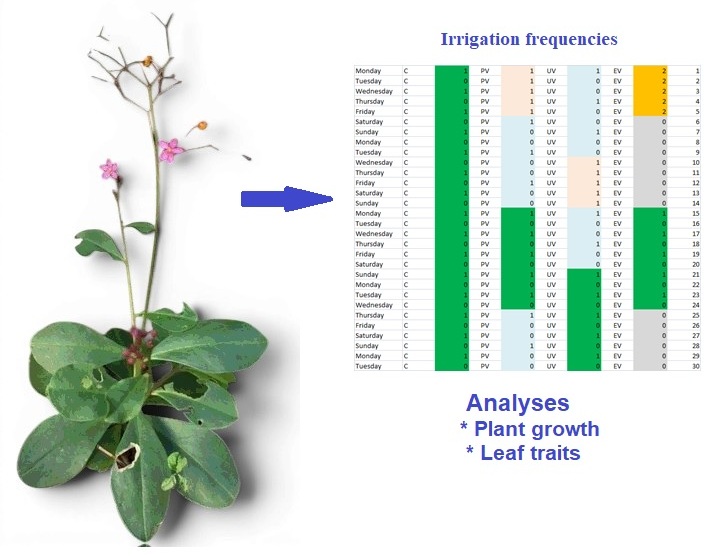
A água é essencial para a sobrevivência das plantas e a compreensão sobre a aclimatação das plantas às variações de irrigação é necessária considerando as mudanças climáticas globais, no entanto, poucos estudos relacionam as respostas das plantas a variações da freqüência de irrigação. Assim, testamos a influência de quatro tratamentos de irrigação em Talinum paniculatum (Jacq.) Gaertn, uma planta tropical comestível: constante (C), variável previsível (PV), variável imprevisível (UV) e variável extrema (EV), mantendo o mesmo número de eventos de irrigação ao final do experimento. Foiavaliado o comprimento de raiz e parte aérea, relação raiz/parte aérea, massa fresca e seca de raiz, parte aérea e folha, número de folhas, densidade estomática, comprimento das células guarda dos estômatos e índice de área estomática. Plantas de T. paniculatum que receberam maior freqüência de irrigação (tratamentos C e PV) apresentaram maior crescimento. Plantas mantidas no tratamento EV exibiram redução do crescimento, com menor comprimento da parte aérea, menor massa fresca e seca da parte aérea e menor número de folhas, comparado aos tratamentos C e PV. Entretanto, plantas do tratamento EV tiveram maior taxa raiz/parte aérea, indicando maior alocação de biomassa para o sistema de raiz, sugerindo estratégia para aumentar a eficiência na absorção de água e aumentar a taxa de sobrevivência sob estresse por seca. Algumas características não diferiram entre os tratamentos, como comprimento da raiz, comprimento das celula-guarda e densidade estomática, o que pode ser devido T. paniculatum ser uma planta CAM facultativa. Assim, T. paniculatum responde a mudanças na frequência de irrigação e avaliar as respostas de plantas tropicais a diferentes frequências de precipitação pode favorecer nossa previsão de respostas da vegetação em vista das mudanças atuais de precipitação.
Referências
Allan RP, Soden, BJ. Atmospheric warming and the amplifi-cation of precipitation extremes. Science, v. 321, n. 5895, p. 1481-1484, 2008. https://doi.org/10.1126/science.1160787
Anderegg WRL. Spatial and temporal variation in plant hy-draulic traits and their relevance for climate change impacts on vegetation. New Phytologist, v. 205, n. 3, p. 1008-1014, 2015. https://doi.org/10.1111/nph.12907
Aparecido, LEO et al. Köppen, Thornthwaite and Camargo climate classifications for climatic zoning in the State of Pa-raná, Brazil. Ciência e Agrotecnologia, v. 40, p. 405-417, 2016.
Bertolino LT, Caine RS, Gray JE. Impact of stomatal density and morphology on water-use efficiency in a changing world. Frontiers in plant science, v. 10, p. 225, 2019. https://doi.org/10.3389/fpls.2019.00225
Biondo E, Fleck M, Kolchinski EM, Sant’Anna V, Polesi RG. Diversidade e potencial de utilização de plantas alimentícias não convencionais no Vale do Taquari, RS. Revista Eletrô-nica Científica da UERGS, v. 4, n. 1, p. 61-90, 2018.
Bjorkman AD. et al. Plant functional trait change across a warming tundra biome. Nature, v. 562, n. 7725, p. 57-62, 2018.
https://doi.org/10.1038/s41586-018-0563-7
Borrajo CI, Sánchez-Moreiras, AM, Reigosa, MJ. Morpho-physiological responses of tall wheatgrass populations to different levels of water stress. PloSone, v. 13, n. 12, p. e0209281, 2018.
Broennimann O, Thuiller W, Hughes G, Midgley GF, Alkemade JMR, Guisan A. Do geographic distribution, niche property and life form explain plants' vulnerability to global change?. Global Change Biology, v. 12, n. 6, p. 1079-1093, 2006.
https://doi.org/10.1111/j.1365-2486.2006.01157.x
Castro CM, Devide ACP. Plantas alimentícias não-convencionais: sazonalidade no Vale do Paraíba. Pindamo-nhangaba: Agência Paulista de Tecnologia dos Agronegó-cios, 2013. 66p
Correia, MJ, Coelho, D, David, MM. Response to seasonal drought in three cultivars of Ceratonia siliqua: leaf growth and water relations. Tree Physiology, v. 21, n. 10, p. 645-653, 2001.
Dalal A, Attia Z,MoshelionM. To produce or to survive: how plastic is your crop stress physiology?. Frontiers in plant science, v. 8, p. 2067, 2017. https://doi.org/10.3389/fpls.2017.02067
Davatgar N, Neishabouri MR, Sepaskhah AR, Soltani A. Physiological and morphological responses of rice (Oryza sativa L.) to varying water stress management strate-gies. International Journal of Plant Production,v.3, p. 19-32, 2009.
https://doi.org/10.22069/IJPP.2012.660
Fang Y et al. Moderate drought stress affected root growth and grain yield in old, modern and newly released cultivars of winter wheat. Frontiers in Plant Science, v. 8, p. 672, 2017.
https://doi.org/10.3389/fpls.2017.00672
Felton AJ, Knapp AK, Smith MD. Precipitation–productivity relationships and the duration of precipitation anomalies: an underappreciated dimension of climate change. Global Change Biology, v. 27, n. 6, p. 1127-1140, 2021.
https://doi.org/10.1111/gcb.15480
Güerere I, Tezara W, Herrera C, Fernández MD.Recycling of CO2 during induction of CAM by drought in Talinum pa-niculatum (Portulacaceae). Physiologia Plantarum, v. 98, n. 3, p. 471-476, 1996.
Herrera A. Crassulacean acid metabolism and fitness under water deficit stress: if not for carbon gain, what is facultative CAM good for?. Annals of botany, v. 103, n. 4, p. 645-653, 2009.
https://doi.org/10.1093/aob/mcn145
Husen A, Iqbal M, Aref I. M. Plant growth and foliar charac-teristics of faba bean (Vicia faba L.) as affected by indole-acetic acid under water-sufficient and water-deficient condi-tions. Journal of Environmental Biology, v. 38, n. 2, p. 179, 2017.
https://doi.org/10.22438/jeb/38/2/MS-247
Jensen NB, Vrobel O, Nageshbabu NA, Diego ND, Tarkow-ski P, Ottosen C-O, Zhou R. Stomatal effects and ABA me-tabolism mediate differential regulation of leaf and flower cooling in tomato cultivars exposed to heat and drought stress. Journal of Experimental Botany, v. 75, n. 7 p. 2156–2175, 2024.
https://doi.org/10.1093/jxb/erad498
Kim J-S, Kidokoro S, Yamaguchi-Shinozaki K, Shinozaki K. Regulatory networks in plant responses to drought and cold stress. Plant Physiology, v. 195, p. 170–189, 2024.
Kinupp VF, Lorenzi H. Plantas Alimentícias Não Convencio-nais (PANCs) no Brasil: guia de identificação, aspectos nu-tricionais e receitas ilustradas. São Paulo: Instituto Planta-rum. 2014; 768p.
Knapp, AK. et al. Characterizing differences in precipitation regimes of extreme wet and dry years: implications for cli-mate change experiments. Global change biology, v. 21, n. 7, p. 2624-2633, 2015.
https://doi.org/10.1111/gcb.12888
Liu W, Xie F, Chen Y, Cui G. Growth and Morphological Responses of Kentucky Bluegrass to Homogeneous and Heterogeneous Soil Water Availabilities. Agronomy, v. 12, n. 6, p. 1265, 2022.
Ma Y, Zhang Y, Xu J, Qi J, Liu X, Guo L, Zhang H. Re-search on the Mechanisms of Phytohormone Signaling in Regulating Root Development. Plants, v. 13, p. 3051-3066, 2024.
https://doi.org/10.3390/plants13213051
Memmott J, Craze PG, Waser NM. Global warming and the disruption of plant–pollinator interactions. Ecology letters, v. 10, n. 8, p. 710-717, 2007.
https://doi.org/10.1111/j.1461-0248.2007.01061.x
Moler ERV, Kolb T, Brady A, Palmiero BN, Wallace TR, Waring KM, Whipple AV. Plant developmental stage influ-ences responses of Pinus strobiformis seedlings to experi-mental warming. Plant‐Environment Interactions, v. 2, n. 3, p. 148-164, 2021.
https://doi.org/10.1002/pei3.10055
Mondoni A, Rossi G, Orsenigo S, Probert RJ. Climate warm-ing could shift the timing of seed germination in alpine plants. Annals of Botany, v. 110, n. 1, p. 155-164, 2012. https://doi.org/10.1093/aob/mcs097
Moura IO et al. Chemical characterization, antioxidant activity and cytotoxicity of the unconventional food plants: sweet potato (Ipomoea batatas (L.) Lam.) leaf, major gomes (Talinum paniculatum (Jacq.) Gaertn.) and caruru (Amaran-thus deflexus L.). Waste and Biomass Valorization, v. 12, n. 5, p. 2407-2431, 2021.
https://doi.org/10.1007/s12649-020-01186-z
Osakabe Y, Osakabe K, Shinozaki K, Tran L-SP. Response of plants to water stress. Frontiers in plant science, v. 5, p. 86, 2014.
https://doi.org/10.3389/fpls.2014.00086
Prince SJ, Murphy M, Mutava RN, Durnell LA, Valliyodan B., Shannon JG, Nguyen HT. Root xylem plasticity to im-prove water use and yield in water-stressed soy-bean. Journal of experimental botany, v. 68, n. 8, p. 2027-2036, 2017.
https://doi.org/10.1093/jxb/erw472
Riederer M, Schreiber L. Protecting against water loss: analy-sis of the barrier properties of plant cuticles. Journal of ex-perimental botany, v. 52, n. 363, p. 2023-2032, 2001. https://doi.org/10.1093/jexbot/52.363.2023
Shao H-B, Chu L-Y, Jaleel, CA, Zhao C-X. Water-deficit stress-induced anatomical changes in higher plants. Comptesrendusbiologies, v. 331, n. 3, p. 215-225, 2008.
https://doi.org/10.1016/j.crvi.2008.01.002
Scheiner SM. Selection experiments and the study of pheno-typic plasticity. Journal of Evolutionay Biology, v. 15, p. 889-898, 2002.
Taura HM, Laroca S, Barbosa JF, Rodrigues J. Melissocenó-tica (Apoidea, Anthophila) no Parque Florestal dos Pionei-ros, Maringá, PR (sul do Brasil): Parte II. Utilização de re-cursos florais. Acta Biológica Paranaense, v. 36, n. 3-4, p. 175-192. 2007
Thanamool C, Papirom P, Chanlun S, Kupittayanant S. Tali-num paniculatum (Jacq.) Gertn: a medicinal plant with po-tential estrogenic activity in ovariectomized rats. International Journal of Pharmacy and Pharmaceutical Sciences, v. 5, n. 2, p. 478-485, 2013.
Trenberth KE, Dai A, Schrier G van der, Jones PD, Barichiv-ich J, Briffa KR, Sheffield J. Global warming and changes in drought. Nature Climate Change, v. 4, n. 1, p. 17-22, 2014.
https://doi.org/10.1038/nclimate2067
Valerio R, Ramirez N. Depresión Exogámica y Biología re-productiva de Talinum paniculatum (Jacq.) Gaertner (Portu-lacaceae). Acta Botánica Venezuelica, v.26, n.2, p.111-124, 2003.
Valladares, F. A mechanistic view of the capacity of forests to cope with climate change. In: Managing forest ecosystems: the challenge of climate change. Springer, Cham, 2017. p. 15-40.
https://doi.org/10.1007/978-1-4020-8343-3_2
Varol T, Canturk U, Cetin M, Ozel HB, Sevik H. Impacts of climate change scenarios on European ash tree (Fraxinus excelsior L.) in Turkey. Forest Ecology and Management, v. 491, p. 119199, 2021. https://doi.org/10.1016/j.foreco.2021.119199
Varol T, Cetin M, Ozel HB, Sevik H, Cetin IZ. The effects of climate change scenarios on Carpinus betulus and Carpinus orientalis in Europe. Water, Air, & Soil Pollution, v. 233, n. 2, p. 1-13, 2022.
https://doi.org/10.1007/s11270-022-05516-w
Wang, JH, Chen W, Ma, RJ, Baskin CC, Baskin JM, Qi W, Chen XL. Role of short-term cold stratification on seed dormancy break and germination of alien species in south-eastern China. Plant Ecology, v. 217, n. 4, p. 383-392, 2016.
Wu, J, Wang, J, Hui W, Zhao F, Wang P, Su C, Gong W. Physiology of Plant Responses toWater Stress and Related Genes: A Review. Forests, v. 13, p. 324-339, 2022. https://doi.org/10.3390/f13020324
Yan S, Weng B, Jing L, Bi, W, Yan D. Adaptive pathway of summer maize under drought stress:Transformation of root morphology and water absorption law. Front. Earth Sci., v. 10, p.1020553, 2022.
doi: 10.3389/feart.2022.1020553
Zeppel, MJB,Wilks JV, Lewis JD. Impacts of extreme precipi-tation and seasonal changes in precipitation on plants. Biogeosciences, v. 11, n. 11, p. 3083-3093, 2014.
Downloads
Publicado
Como Citar
Edição
Seção
Licença
Copyright (c) 2026 Kariny Cari Nascimento, Lindamir Pastorini

Este trabalho está licenciado sob uma licença Creative Commons Attribution 4.0 International License.
Copyright (c) 2024 - Journal of Biotechnology and Biodiversity

Este obra está licenciado com uma Licença Creative Commons Atribuição 4.0 Internacional.
Autores que publicam nesta revista concordam com os seguintes termos:
Autores mantêm os direitos autorais e concedem à revista o direito de primeira publicação, com o trabalho simultaneamente licenciado sob a Licença Creative Commons Attribution (CC BY 4.0 no link http://creativecommons.org/licenses/by/4.0/) que permite o compartilhamento do trabalho com reconhecimento da autoria e publicação inicial nesta revista.
Autores têm autorização para assumir contratos adicionais separadamente, para distribuição não exclusiva da versão do trabalho publicada nesta revista (ex.: publicar em repositório institucional ou como capítulo de livro), com reconhecimento de autoria e publicação inicial nesta revista.
Autores têm permissão e são estimulados a publicar e distribuir seu trabalho online (ex.: em repositórios institucionais ou na sua página pessoal) a qualquer momento antes ou durante o processo editorial, já que isso pode gerar alterações produtivas, bem como aumentar o impacto e a citação do trabalho publicado (disponibilizado em O Efeito do Acesso Livre no link http://opcit.eprints.org/oacitation-biblio.html).