Água como fator modificador da fertilidade do solo no estuário do Rio Guamá
DOI:
https://doi.org/10.20873/jbb.uft.cemaf.v13n1.18551Palavras-chave:
inundação, nutrientes, gleissolos, mineralogia, matéria orgânicaResumo
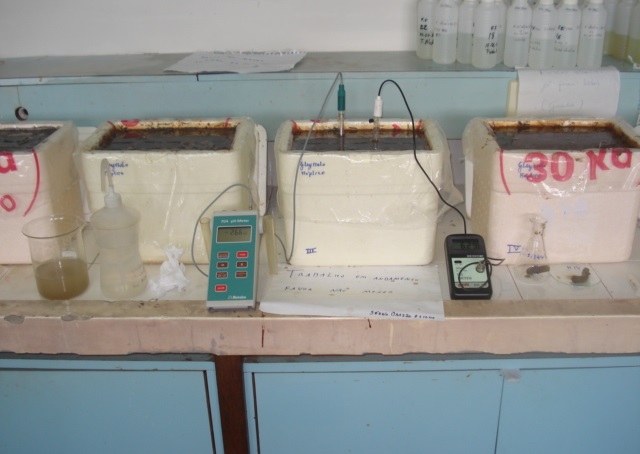
O estuário do rio Guamá, no norte do Brasil, possui grandes áreas férteis de várzea com considerável potencial para a produção de alimentos. Com o objetivo de avaliar os efeitos da inundação na geoquímica do solo, foi realizado um experimento de inundação prolongada em um Gleissolo Háplico do Rio Guamá, enquanto foram avaliadas a mineralogia e a fertilidade do solo e da água do rio em suspensão. O objetivo do estudo foi investigar os processos geoquímicos que ocorrem no horizonte superficial dos Gleissolos Háplicos do Rio Guamá. Durante o experimento, o solo foi inundado com água destilada e amostras foram coletadas em intervalos regulares. Houve uma redução acentuada de 322 mV no primeiro dia para -337 mV no 132º dia de inundação. O pH, que inicialmente era 4,6, aumentou gradativamente até o 15º dia de cheia, quando se estabilizou em torno de 6,5 a 6,7. Os nutrientes ferro, fósforo e manganês aumentaram consideravelmente no complexo de trocas, com o ferro atingindo níveis elevados para a nutrição das plantas. O potássio não respondeu ao efeito das enchentes e, assim como o cálcio, sua concentração mudou pouco. As concentrações de cobre e zinco aumentaram apenas ligeiramente durante as cheias, mas permaneceram em níveis adequados. As características mineralógicas deste solo indicaram a presença de goethita, quartzo, esmectita, ilita, caulinita e anatásio. O material suspenso revelou altos níveis de cátions trocáveis adsorvidos ao sedimento, com alta CTC, baixa saturação por alumínio e alta saturação por bases. A frequente deposição de silte no solo, aliada à presença de matéria orgânica e argilominerais na proporção 2:1 no solo, contribui para a manutenção da fertilidade deste ambiente.
Referências
Barbosa, T. M. B. Mineralogia e disponibilidade de fósforo em solos de terra firme da Amazônia Central. Tese (Douto-rado em Agronomia Tropical). Universidade Federal do Amazonas, Manaus, 2017, 85p.
Batista, M.A., Inoue, T.T., Esper Neto, M., and Muniz, A.S. Princípios de fertilidade do solo, adubação e nutrição mine-ral. Hortaliças-fruto [online]. Maringá: EDUEM, 2018, pp. 113-162. ISBN: 978-65-86383-01-0.
Bertoni, J. C.; Holanda, F. S. R.; Carvalho, J. G. De; Paula, M. B. De; Assis, M. P. De 1999. Efeito Do Cobre Na Nu-trição Do Arroz Irrigado Por Inundação - Teores E Acúmu-lo De Nutrientes. Ciênc. Agrotec., Lavras, V. 23, N.3, P. 547-550.
Brito, Aline Dias et al. Saberes e práticas tradicionais da extra-ção do óleo de Carapa guianenses Abul.(andiroba) em área de várzea do município de Igarapé-Miri, PA. Revista Brasi-leira de Agroecologia, v. 15, n. 3, p. 13-13, 2020.
Camargo, F.A. de O., Santos, G. de A., Zonta, E., 1999. Alterações eletroquímicas em solos inundados. Ciência Ru-ral 29, 171–180.
https://doi.org/10.1590/S0103-84781999000100032
Da Fontoura Júnior, José Acélio Silveria et al. Simulação de diferentes arranjos de sistemas integrados em áreas de vár-zea. Brazilian Journal of Development, v. 6, n. 8, p. 63059-63077, 2020.
Dal Cortivo, Nelsi Santos; Júnior, Ismael Laurindo Costa; Pletsch, Adelmo Lowe. Parâmetros Físico-Químicos Em Diferentes Frações E Classes De Solos Florestais E Agríco-las, No Entorno Do Parque Nacional Do Iguaçu-PR. Geo-ambiente On-line, n. 47, 2023.
Dias Dos Santos, Fernanda et al. Fatores que afetam a dispo-nibilidade de micronutrientes no solo. Tecno-Lógica, v. 25, n. 2, 2021.
Dos Santos, Gisele Barbosa et al. Gleissolo em ambiente de vereda no chapadão do urucuia, oeste da bahia/gleysol in vereda’s environment at the chapadão do urucuia’s plateau, western Bahia. Geographia Meridionalis, v. 4, n. 1, p. 44-56, 2018.
Embrapa, 2009. Manual De Análises Químicas De Solos, Plantas E Fertilizantes. Silva, F. C. Da (Editor Técnico). 2. Ed. Ver. Ampl. – Brasília, Df: Embrapa Informação Tecno-lógica, 627 P.
Embrapa. Centro Nacional de Pesquisa de Solos. Manual de Métodos de Análise de Solo. 2 ed. Rio de Janeiro: Embrapa Solos, 212 p., 1997.
Empresa Brasileira de Pesquisa Agropecuária (EMBRAPA). (2018). Sistema Brasileiro de Classificação dos Solos.Ed.5, Brasília.
Ferrando, M., Mercado,G.; Hernandez, J. 2002. Dinámica Del Hierro E Do Fósforo Durante Período Cortos De Anaerobi-osis In Los Suelos. Agrociencia. V. Vi, 1:1-9.
Ferreira, D. F. 2007 Sisvar: Sistema De Análise De Variância. Versão 5.0. Lavras: Ufla/Dex.
Ferreira, D. F. SISVAR: A Computer analysis system to fixed effects split plot type designs; Sisvar. Brazilian Journal of Biometrics, v. 37, n.4, p.529–535, 2019.
Ferreira, T. O.; Vidal-Torrado, P., Otero, X. L., Macias, F. 2007. Are Mangrove Forest Substrates Sediments Or Soil? A Case Study In Southeastern Brazil. Catena 70:79-91.
Ferreira, W. De A.; Botelho, S. M. 1999. Efeito Da Inundação Sobre As Propriedades De Um Gleissolo Sálico Sódico De Várzea Do Rio Dos Morcegos, No Município De Primave-ra, Pará. Belém: Embrapa Amazônia Orienta. Boletim de Pesquisa, 21. 24 P.
Ferreira, W. De A.; Modesto Júnior, M. De S.; Botelho, S. M.; Mascarenhas, R. E. B. 1998. Efeito Da Inundação So-bre As Propriedades De Um Glei Pouco Húmico De Várzea do Rio Guamá, Nos Municípios De Belém E Santa Isabel, Pa. Belém: Embrapa-Cpapu, Boletim De Pesquisa, 207. 29 P.
Garcia, C. H. P.; Lima, H. N.; Silva, F. W. R.; Junior, N.; Ferreira, A.; Teixeira, W. G.; Macedo, R. S.; Tavares, S. G. Chemical properties and mineralogy of soils with plinthite and petroplinthite in Iranduba (AM), Brazil. Revista Brasi-leira de Ciência do Solo, Viçosa, v. 37, p. 936- 946, 2013.
Gomes, Mariano et al. Atributos físicos e químicos do solo e uso das terras das ilhas do rio São Francisco. Caderno de Ciências Agrárias, v. 7, n. 1, p. 34-45, 2015.
Guyot, J. L,; Jouanneau, J. M.; Soares, L.; Boaventura, G. R.; Maillet, N.; Lagane, C. 2007. Clay Mineral Composition Of River Sediments In The Amazon Basin. Catena. 71:340-356.
Hatje, V., Pedreira, R.M.A., DE Rezende, C.E., Schettini, C.A.F., DE Souza, G.C., Marin, D.C., Hackspacher, P.C.. The environmental impacts of one of the largest tailing dam failures worldwide. Scientific reports, v. 7, n. 1, p. 10706, 2017.
Hiraoka, M. 1995. Land Use Changes In The Amazon Estu-ary. Global Environmental Change, (5) 4:323-333.
Junk W.J.; Piedade,,M.T.F.; Wittmann F.; Schongart J. 2020. Várzeas Amazônicas: Desafios para um Manejo Sustentá-vel. - Manaus: Editora do INPA.
Junk, W. J. Condições físico-químicas dos solos na várzea da Amazônia Central. Desafios para um Manejo Sustentável, p. 77, 2020.
Junk, W. J. et al. Brazilian wetlands: Their definition, delinea-tion, and classification for research, sustainable manage-ment, and protection. Aquatic Conservation: Marine and Freshwater Ecosystems, [s. l.], v. 24, n. 1, p. 5–22, 2014.
Junk, W.J.; Piedade, M.T.F.; Schöngart, J.; Cohn-Haft, M.; Adeney, J.M.; Wittmann. A classification of major natural-ly-occurring Amazonian lowland wetlands. Wetlands, v. 31, p. 623-640, 2011.
Kristensen, E.; Bouillon, S.; Dittmar, T.; Marchand, C. 2008. Organic Carbon Dynamics In Mangrove Ecosystems: A Review. Aquatic Botany 89:201-219.
Lima, H. N.; Mello, J. W. V. De; Schaefer, C. E. G. R.; Ker, J. C. 2005. Dinâmica Da Mobilização De Elementos Em So-los Da Amazônia Submetidos À Inundação. Acta Amazoni-ca, V. 35(3), P. 317-330.
Lima, R. R.; Tourinho, M. M.; Costa, J. P. C. Da. 2001. Várzeas Flúvio-Marinhas Da Amazônia Brasileira: Caracte-rísticas E Possibilidades Agropecuárias. Belém: Fcap. Ser-viço De Documentação E Informação, 342 P.
Lopes, E. L. N.; Fernandes, A. R.; Grimaldi, C.; Ruivo, M. De L. P.; Rodrigues, T. E.; Sarrazin, M. 2006. Características Químicas De Um Gleissolo Sob Diferentes Sistemas De Uso, Nas Margens Do Rio Guamá, Belém, Pará. Bol. Mus. Par. Emílo Goeldi. Belém, V. 1, 1:127-137.
Lopes; A. S.; Guilherme, L. R. G. 2004. Interpretação De Análise De Solo: Conceitos E Aplicações. Anda - Boletim Técnico, Nº 2. Edição Revisada. São Paulo. 50 P.
Malepfane, Ntwanano Moirah et al. Land use and site effects on the distribution of carbon in some humic soil profiles of KwaZulu-Natal, South Africa. Heliyon, v. 8, n. 1, 2022.
Marques, J. D. O.; Teixeira, W. G.; Reis, A. M.; Junior, O. F. C.; Batista, S. M.; Afonso, M. A. C. B. Atributos químicos, físico-hídricos e mineralogia da fração argila em solos do Baixo Amazonas: Serra de Parintins. Acta Amazonica, v. 40, p. 1-12, 2010.
Mattar, R. M. V. C.; Vieira, L. S.; Silva, G. R. 2002. Efeito Da Inundação Sobre O Ph E A Disponibilidade De Fósforo, Sódio, Ferro E Manganês Em Um Gley Pouco Húmico Co-letado Na Várrzea Do Rio Guamá, Belém (Pa). Revista De Ciências Agrárias, N. 37, P.113-121.
Melo, J. W. V.; Fontes, M. P. F.; Ribeiro, A. C.; Alvarez, V. V. H. 1992. Inundação E Calagem Em Solos De Várzea: I. Alterações Em Ph, Eh, E Teores De Fe2+ E Mn2+ Em So-lução. R. Bras. Ci. Solo. Campinas, V.16, P. 309-317.
Meurer, E. J. Fundamentos da química do solo. Ed. Porto Alegre: Evangraf, 5ªed. 280p. 2012.
Muner, L. H. D.; Ruiz, H. A.; Venegas, V. H.; Neves, J. C.; Freire, F. J.; Freire, M. B. D. S. Disponibilidade de zinco para milho em resposta à localização de fósforo no solo. Re-vista Brasileira de Engenharia Agrícola e Ambiental, v. 15, n. 1, p. 29-38, 2011.
Nguyen, B. T.; Marschner, P. 2005. Effect Of Drying And Rewetting On Phosphorus Transformations In Red Brown Soils With Different Soil Organic Matter Content. Soil Bio-logy And Biochemistry. 37 1573-1576 P.
Norgaard, R. B. (2019). Significação do potencial para produ-zir arroz com irrigação controlada na várzea amazônica. Re-vista de Economia e Sociologia Rural, 19(2), 287-313.
Otero, X. L.; Ferreira, T. O., Huerta-Diaz, M. A., Partiti, C. S. M.; Souza J. R., V.; Vidal-Torrado, P.; Macias, F. 2009. Geochemistry Of Iron And Manganese In Soils And Sedi-ments Of A Mangrove System, Island Of Pai Matos (Cana-néia-Sp, Brazil). Geoderma, 148, P. 318-335.
Pereira, Denison da Silva. Dinâmica socioespacial em comuni-dades ribeirinhas das ilhas de Abaetetuba-PA. 2014. Tese de Doutorado. Dissertação (Mestrado). Universidade Federal do Pará, Instituto de Filosofia e Ciências Humanas, Progra-ma de Pós-Graduação em Geografia Belém.
Pezeshki, S.R. & Delaune, R.D. Soil Oxidation-Reduction in Wetlands and Its Impact on Plant Functioning. Biology, v.1, p: 196-221. 2012.
Ponnamperuma, F. N. 1972. The Chemistry Of Submerged Soils. Advances In Agronomy, New York, N.24, P29-96.
Rodrigues, Renato dos Prazeres; Medeiros, Monique. Ativi-dades socioprodutivas e tipologias de Unidades de Produção Familiar de camponeses-ribeirinhos em várzea do Baixo To-cantins. Revista de Economia e Sociologia Rural, v. 62, p. e264420, 2023.
Sanches, P. A. 1981. Suelos Del Tropico:Caracteristicas Y Manejo. San Jose, Costa Rica: Iica, P. 430-446.
Schwertmann, U.; Taylor, R. R. 1989. Iron Oxides. In: Dix-on, J.B.; Weed, S.B. (Eds.) Mineral In Soils Environments. Madson, Soil Science Society Of America, P. 379-438.
Silva GJ, Neves SMAS, De Paula WCS, Da Silva VN (2017). Relação da cobertura vegetal e uso do solo com o ndvi e a temperatura superficial da área não inundável do pantanal de Cáceres/MT. Simpósio Brasileiro de Geografia Física Aplicada.v1i.
Silva, P. A. L. Da; 2008. Efeito Da Inundação Sobre O Enxo-fre E Outros Atributos Químicos De Um Gleissolo Háplico Da Várzea Do Rio Guamá, Belém-Pa. Dissertação Mestra-do. Universidade Federal Rural Da Amazônia. 60p.
Silva, S. B. E. 2010. Belém E O Ambiente Insular. Belém: Universidade Federal Da Amazônia. 165 P.
Silva, S. B. E; Vieira, L. S.; Ferreira, W. De A. 1996. Avalia-ção Da Disponibilidade De Nutrientes Em Várzea Inundada Do Rio Guamá. Belém: Fcap. Serviço De Documentação E Informação. Fcap, Informe Técnico, 18. 18 P.
Silva, Sérgio Brazão et al. Interações geoquímicas na superfí-cie de gleissolos no Estuário Amazônico. 2023. Tese (Dou-torado em Geologia e Geoquímica) – Universidade Federal Rural da Amazônia.
Smanhotto, A.; Sousa, A. D. P.; Sampaio, S. C.; Nóbrega, L. H.; Prior, M. Cobre e zinco no material percolado e no solo com a aplicação de água residuária de suinocultura em solo cultivado com soja. Engenharia Agrícola, v. 30, n. 2, p. 347-357, 2010.
Tourinho, M. M.; Gama, J. R. V.; Bentes-Gama, M. De M.; Santos, S. R. M. Dos Várzeas Do Estuário Do Rio Amazo-nas: Características E Possibilidades Agronômicas. In: Ga-ma, J. R. V.; Palha, M. Das D. C.; Santos, S. R. M. Dos (Organizadores) A Natureza E Os Ribeirinhos. . Belém: Universidade Federal Rural Da Amazônia. 2009. P. 269-293.
Vieira, L. S. 1966. Ocorrência E Formas De Fósforo Em Solos Da Amazônia, Brasil. Dissertação Mestrado. Costa Rica. Turrialba, Iica, Mg. Sci. T. 110 P.
Vilhena, M. Do P. S. P.; Costa, M. L. Da; Berredo, J. F. 2010. Continental And Marine Contributions To Formation Of Mangrove Sediments In Eastern Amazônia Mudplain: The Case Of Marapanim Estuary. Jornal Of South America Earth Science, Elsevier Ltd.. p. 427-438.
Willet, I. R. 1989, Causes And Prediction Of Changes In Extractable Phosphorus During Flooding. Aust. J. Soil Res. 27 45-54 P.
Downloads
Publicado
Como Citar
Edição
Seção
Licença
Copyright (c) 2024 Sérgio Brazão e Silva, Marcondes Lima da Costa, Jessivaldo Rodrigues Galvão, Mauro Junior Borges Pacheco, Matheus Vinícius da Costa Pantoja, Odete Kariny Souza Santos

Este trabalho está licenciado sob uma licença Creative Commons Attribution 4.0 International License.
Copyright (c) 2024 - Journal of Biotechnology and Biodiversity

Este obra está licenciado com uma Licença Creative Commons Atribuição 4.0 Internacional.
Autores que publicam nesta revista concordam com os seguintes termos:
Autores mantêm os direitos autorais e concedem à revista o direito de primeira publicação, com o trabalho simultaneamente licenciado sob a Licença Creative Commons Attribution (CC BY 4.0 no link http://creativecommons.org/licenses/by/4.0/) que permite o compartilhamento do trabalho com reconhecimento da autoria e publicação inicial nesta revista.
Autores têm autorização para assumir contratos adicionais separadamente, para distribuição não exclusiva da versão do trabalho publicada nesta revista (ex.: publicar em repositório institucional ou como capítulo de livro), com reconhecimento de autoria e publicação inicial nesta revista.
Autores têm permissão e são estimulados a publicar e distribuir seu trabalho online (ex.: em repositórios institucionais ou na sua página pessoal) a qualquer momento antes ou durante o processo editorial, já que isso pode gerar alterações produtivas, bem como aumentar o impacto e a citação do trabalho publicado (disponibilizado em O Efeito do Acesso Livre no link http://opcit.eprints.org/oacitation-biblio.html).